
Aug 27,2026
What Are CNC Diamond Grinding Wheels Used for
Choosing the right diamond grit size for glass grinding is an important part of balancing grinding efficiency, edge quality, material removal, and wheel service life. A grit that works well for aggressive material removal may not be the best option when the process requires a smoother glass edge or tighter dimensional control.
The choice also depends on more than the glass itself. Glass thickness, required material removal, grinding speed, edge quality, machine configuration, wheel profile, and processing conditions can all influence the appropriate glass grinding wheel grit size.
For this reason, there is no universal grit that is best for every glass grinding application. A practical selection process starts with the production requirements and then matches the diamond grit to the actual grinding conditions. The following guide explains how different grit sizes affect grinding performance and how manufacturers can approach grit selection for PV and appliance glass processing.
Diamond grit size refers to the size range of the diamond abrasive particles used in a grinding wheel. Common specifications for glass grinding wheels include 80#, 150#, 200#, 300#, and 400#. The grit specification is one of the factors that determines how the abrasive interacts with the glass during grinding.
In general, coarser diamond grit provides a more aggressive cutting action and can be useful when relatively high material removal is required. Finer grit provides a greater emphasis on controlled grinding and finishing characteristics. However, grit number should not be treated as an independent indicator of overall wheel performance.
The same grit can behave differently depending on the wheel's bond, diamond concentration, profile, machine parameters, glass characteristics, and grinding conditions. Therefore, diamond grit for glass grinding should always be considered as part of the complete wheel specification rather than as a single parameter.
The numbers identify different abrasive particle size ranges. Within a grinding wheel specification, the choice between 80#, 150#, 200#, and 400# represents a change in abrasive characteristics rather than a simple quality ranking.
For example, an 80# wheel and a 400# wheel should not be viewed as the same tool with different levels of performance. They are intended to provide different grinding characteristics and may be appropriate under different processing conditions.
A useful way to understand the range is to consider the desired balance:
Coarser grit → greater emphasis on material removal and grinding aggressiveness
Finer grit → greater emphasis on controlled grinding and finish
This does not mean that every production line should automatically move toward coarse grit for efficiency or fine grit for quality. The correct choice depends on what the grinding operation needs to accomplish.
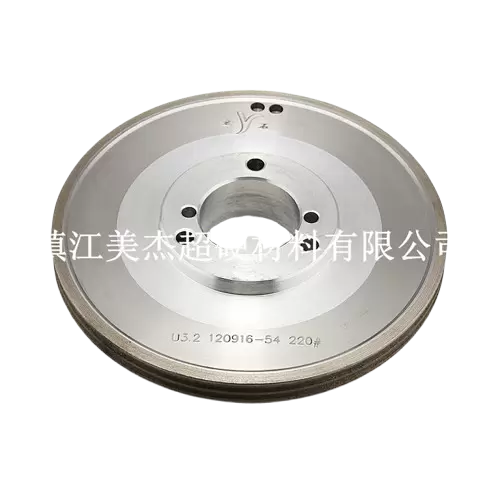
The primary reason grit size matters is that it changes the interaction between the abrasive and the glass surface. That interaction affects material removal, grinding behavior, edge quality, and the way the wheel wears during operation.
For manufacturers selecting a glass grinding wheel grit size, these effects should be considered together rather than evaluated separately.
When the grinding process requires significant material removal, a coarser diamond grit can provide a more aggressive grinding action. Larger abrasive particles can engage the glass more actively and support efficient stock removal under suitable operating conditions.
This can be particularly relevant to processes involving heavy grinding or higher production requirements. In such applications, grinding efficiency is often closely connected with feed rate, grinding depth, wheel sharpness, and machine stability.
However, grit size alone does not determine the material removal rate. A coarser wheel operated under unsuitable conditions may not provide the expected productivity improvement. Excessive grinding pressure, an inappropriate feed rate, poor cooling, or an unsuitable wheel specification can negatively affect the process.
For this reason, grinding efficiency should be considered as the result of the complete grinding system.
The practical question is not simply:
“Which grit is the coarsest?”
It is:
“Which grit provides sufficient material removal while maintaining the required edge quality and process stability?”
That distinction is important when selecting a diamond grinding wheel for glass.
Grit size can also influence the characteristics of the finished glass edge.
When an application places greater emphasis on controlled finishing, a finer grit may be considered because the abrasive action is generally more suited to finishing-oriented grinding conditions. This can be relevant when the final edge needs a controlled appearance, dimensional accuracy, or reduced surface irregularity.
However, fine grit should not automatically be interpreted as a solution to every glass edge problem. Glass edge quality depends on multiple factors, including wheel condition, grinding depth, feed rate, machine vibration, cooling, and the condition of the glass itself.
A wheel with an unsuitable specification can still produce poor results even when a fine grit is selected.
This is particularly important for manufacturers experiencing edge defects. Changing from a coarse grit to a fine grit may alter the grinding behavior, but it does not eliminate the need to investigate the complete processing system.
Grit size is also related to the way a grinding wheel behaves as it wears, but it should not be used as the sole measure of diamond grinding wheel life.
Actual service life depends on the abrasive, bond, diamond concentration, glass characteristics, grinding pressure, feed rate, machine condition, and other operating factors.
A wheel that provides good cutting performance but wears rapidly may require frequent replacement. Conversely, a wheel with a suitable grinding ratio and stable abrasive retention can support longer production intervals.
Therefore, when evaluating glass grinding wheel wear, manufacturers should look at total production performance rather than only the grit number.
Important indicators include:
A grit that performs well in actual production may therefore provide greater value than one selected solely because it appears more aggressive or finer on paper.
There is no universal answer to whether coarse or fine diamond grit is better for glass grinding. Each has a different role, and the appropriate choice depends on the processing objective.
The key distinction is whether the operation places greater emphasis on material removal and productivity or on controlled grinding and finish quality.
Coarse diamond grit can be appropriate when the process requires relatively high material removal. It may be considered for heavier grinding operations where the primary objective is to remove material efficiently rather than achieve the final finishing condition in a single operation.
Potential advantages include:
However, coarse grit needs to be matched with the correct grinding parameters. If the grinding depth or feed rate is excessive, the process may generate unwanted stress on the glass edge.
Therefore, coarse grit for glass grinding should be selected according to the actual stock removal requirement rather than simply choosing the largest available abrasive.
Fine diamond grit can be considered when the process places greater importance on controlled grinding and finish characteristics.
Potential applications include operations where:
A finer grit can be useful for these conditions, but it still needs to be combined with an appropriate bond, wheel specification, machine setup, and grinding process.
The objective is not to choose the finest possible grit. Instead, the goal is to select a grit that provides the required finishing performance without unnecessarily reducing grinding efficiency.
A common mistake is to search for one best grit for glass grinding and apply it to every production line.
In reality, the same glass type can be processed under very different conditions. Two manufacturers may use the same glass thickness but have different machines, feed rates, grinding depths, wheel profiles, and edge-quality requirements.
Consequently, a grit that performs well in one production environment may not produce the same result in another.
The better approach is to establish the required grinding result first and then select the grit according to the process.
Selecting a suitable glass grinding wheel selection involves more than looking at grit numbers. Several production variables need to be considered together.
Glass thickness is an important starting point because it affects the processing conditions and the amount of material that may need to be removed.
The products covered by Meijie include glass-processing applications ranging from 2 to 18 mm, demonstrating that different thicknesses can fall within the same general grinding-wheel product range.
However, glass thickness should not be used as a direct formula for selecting grit.
For example, it would be too simplistic to conclude that thicker glass always requires coarse grit and thin glass always requires fine grit. Material removal, edge geometry, grinding depth, feed rate, and the desired finish can all change the appropriate selection.
Therefore, diamond grit size for different glass thicknesses should be evaluated in the context of the complete process.
The amount of material that needs to be removed is often more directly related to grit selection than glass thickness alone.
A process involving substantial stock removal has different requirements from a light finishing operation. If the production process needs aggressive grinding, a coarser grit may be considered. If only controlled finishing is required, a finer grit may be more appropriate.
The grinding stage should therefore be identified first:
The required grit can then be evaluated according to that stage.
Edge quality is another major consideration.
If the final product requires a controlled, consistent edge, the grinding wheel must be selected according to the required finish and dimensional tolerance. A grit that provides adequate material removal but produces an unacceptable edge condition is not an effective choice.
At the same time, glass chipping during grinding cannot be attributed to grit size alone. Wheel wear, feed rate, grinding depth, vibration, cooling, and machine stability can all contribute to chipping.
This means grit selection should be part of a broader defect-control strategy rather than treated as the only solution to edge problems.
Grinding speed and feed rate affect how aggressively the wheel interacts with the glass.
High-volume production lines may require higher feed rates, making wheel sharpness, wear resistance, and process stability particularly important. Slower precision operations may place more emphasis on controlled material removal and edge quality.
Changing grit without reviewing the operating parameters can therefore produce inconsistent results.
A suitable diamond grinding wheel selection should consider grit size together with the machine's actual operating conditions.
The grinding machine determines many of the physical requirements for the wheel.
Outer diameter, inner diameter, mounting configuration, wheel profile, spindle conditions, and grinding-head configuration all need to be considered.
This is particularly important because a suitable grit cannot compensate for an incompatible wheel specification.
For production applications, the manufacturer should therefore verify:
The final wheel should match both the abrasive requirement and the equipment.
Different glass applications can have different processing priorities. PV glass, appliance glass, and automotive glass may all use diamond grinding wheels, but their production requirements are not identical.
Grit selection should therefore begin with the actual processing objective for each application.
Photovoltaic glass processing often emphasizes production efficiency, stable edge quality, and long-term grinding performance. High-volume processing can make wheel wear and replacement frequency important considerations.
For this application, the PV Glass Grinding Wheel is available with diamond grit sizes from 80# to 400#. The product can process photovoltaic glass with thicknesses from 2 to 18 mm and supports different wheel profiles for edge grinding requirements.
The available range provides flexibility rather than prescribing one universal grit. Manufacturers can consider the required material removal, edge quality, grinding speed, glass thickness, and machine conditions when determining the appropriate specification.
The product is also compatible with mainstream PV glass processing equipment such as Bottero, KLW, Yihai, Demai, and Faborman, which highlights the importance of matching the wheel to the production equipment as well as the abrasive requirement.
For high-throughput PV glass production, grit selection should ultimately support a balance between grinding efficiency, edge quality, and wheel service life.
Appliance glass processing can involve CNC machining centers and different types of glass edging equipment. Depending on the process, manufacturers may require a combination of material removal efficiency, dimensional stability, profile retention, and edge finish.
The Appliance Glass Grinding Wheel is available in diamond grit sizes from 80# to 400#. This range supports different processing requirements, including applications involving heavy grinding and deep-cut, creep-feed operations as well as processes where greater attention is placed on finish quality.
The product also uses vacuum hot-press sintering at 800–1000°C and professional dynamic balancing to support stable operation.
For appliance glass, the appropriate grit should therefore be selected according to the specific grinding stage and required result rather than according to the glass category alone.
Automotive glass introduces another important consideration: edge geometry.
While grit size affects abrasive behavior, the wheel profile also determines how the abrasive contacts and shapes the glass edge. Automotive glass processing can involve V-type, round edge, ladder edge, and flat edge configurations.
Consequently, manufacturers selecting an automotive glass grinding wheel need to consider both abrasive specifications and profile requirements.
This is an important reminder that grit size is only one part of wheel selection. For applications involving complex edge geometry, profile retention and equipment compatibility can be equally important.
A systematic approach can make diamond grinding wheel selection more reliable than choosing a grit based on a single parameter.
Start by identifying the type of glass being processed.
PV glass, appliance glass, and automotive glass can have different production requirements. Knowing the application establishes the initial processing context.
Determine the actual glass thickness and whether multiple thicknesses will be processed on the same production line.
Thickness affects the grinding conditions, but it should be considered together with the amount of material to be removed and the required edge geometry.
Determine how much material needs to be removed from the glass edge.
Heavy grinding and light finishing should not automatically use the same grit specification. A production process with significant stock removal may require a more aggressive abrasive specification, while a finishing operation may require greater control.
Establish the acceptable edge condition before selecting the grit.
Consider:
The required finish helps determine whether the process should prioritize aggressive material removal or more controlled grinding.
Review the machine before finalizing the wheel.
Grinding speed, feed rate, wheel dimensions, spindle configuration, and cooling conditions can all influence wheel performance.
This step is especially important when replacing an existing wheel with a different grit.
After defining the processing requirements, select a suitable grit range and evaluate it under actual production conditions.
The final decision should be based on measurable results such as:
Actual production testing is often more meaningful than choosing a grit solely from a general-purpose recommendation.
Several common assumptions can make grit selection less effective.
These mistakes often occur when manufacturers treat glass grinding wheel grit size as an isolated specification instead of one part of the complete processing system.
No. A finer grit may influence the grinding behavior and can be suitable for applications where controlled edge quality is important, but it cannot guarantee that glass chipping will disappear.
Chipping can result from several interacting factors, including excessive grinding depth, unsuitable feed rate, worn abrasive, machine vibration, poor cooling, incorrect wheel profile, or unstable processing conditions.
This is why changing grit should not be the only response when a production line experiences edge defects.
A better approach is to evaluate the entire grinding process. If the wheel is worn, the grinding parameters are too aggressive, or the machine is generating excessive vibration, changing from a coarse grit to a fine grit may not address the underlying cause.
For manufacturers troubleshooting glass chipping during grinding, grit selection should therefore be considered alongside wheel condition and process parameters.
The ideal grinding-wheel specification is usually the one that provides an acceptable balance among several competing requirements rather than maximizing a single performance indicator.
High-volume production environments generally need stable material removal and predictable wheel performance.
In these conditions, manufacturers should consider:
Material removal + feed rate + wheel sharpness + wear resistance
A more aggressive grit may be appropriate when substantial stock removal is required, but the complete wheel and process must still maintain acceptable edge quality.
Precision-oriented applications may place greater emphasis on edge condition, dimensional stability, and profile accuracy.
Here, manufacturers should consider:
Edge quality + grinding stability + grit + wheel profile
The finest available grit is not automatically the correct answer. The wheel still needs to provide sufficient productivity and remain stable under actual operating conditions.
Wheel cost should not be evaluated only by the purchase price.
A grinding wheel with a higher initial cost may provide better overall economics if it delivers:
For this reason, diamond grinding wheel life and grinding efficiency should be considered together when evaluating total processing cost.
The right diamond grit size for glass grinding is determined by the relationship between the glass, the grinding objective, the machine, and the required finished result. There is no universal grit that delivers the best performance for every application.
Coarser grit can be considered when material removal and grinding efficiency are important, while finer grit may be more suitable for controlled finishing requirements. However, glass thickness, feed rate, grinding depth, wheel profile, bond, machine configuration, and edge-quality requirements also need to be evaluated.
For PV glass, grit selection should support the demands of high-volume production, stable edge quality, and wheel life. For appliance glass, the balance between material removal, dimensional stability, and finish can be particularly important. Other applications, such as automotive glass, may require equal attention to wheel profile and edge geometry.
The most reliable approach is therefore to define the processing requirements first, select an appropriate grit range, and validate the wheel under actual production conditions. This approach allows manufacturers to balance grinding efficiency, edge quality, and wheel life instead of choosing a grit based on a single specification.