
Aug 06,2026
What Is a Diamond Grinding Wheel and How Does It Work?
Coarse grinding and fine grinding are two important stages in semiconductor wafer processing. Although both use an abrasive tool to remove material from the wafer surface, they serve different purposes. Coarse grinding places greater emphasis on efficient material removal and thickness reduction, while fine grinding focuses more on controlled removal, dimensional accuracy, and surface quality.
The distinction matters because the grinding conditions used for one stage may not be appropriate for the other. Abrasive grit, grinding depth, feed rate, wheel condition, and wafer material all affect how the grinding tool interacts with the workpiece. Understanding these differences helps manufacturers select suitable grinding conditions and maintain consistent wafer quality.
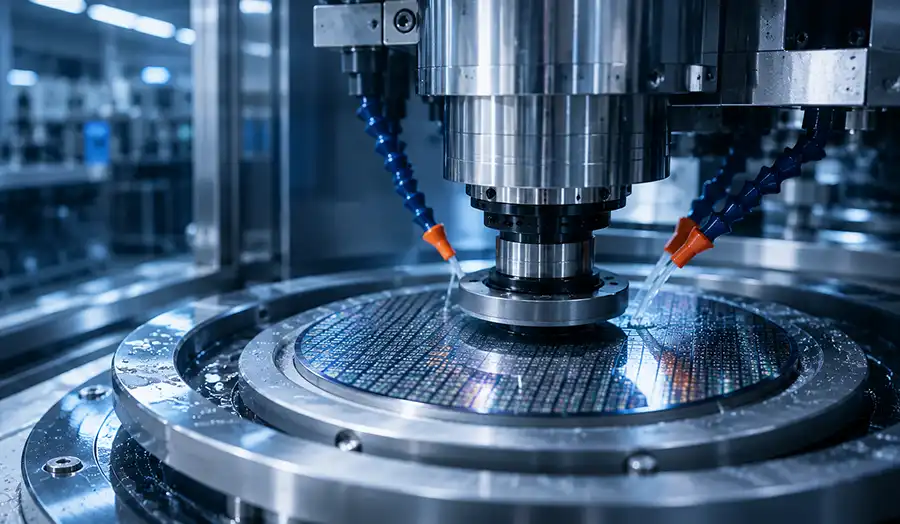
In semiconductor wafer processing, coarse grinding is generally the stage used to remove a relatively large amount of material. Its main purpose is to reduce wafer thickness efficiently and bring the workpiece closer to the required dimensions.
Fine grinding follows with more controlled material removal. Once the wafer is closer to its target thickness, the priority shifts toward thickness accuracy, surface roughness, and consistency across the processed surface.
The two stages can therefore be distinguished by their primary processing objectives rather than simply by the abrasive size used.
| Aspect | Coarse Grinding | Fine Grinding |
|---|---|---|
| Main purpose | Efficient material removal | Controlled material removal |
| Material removal | Relatively high | Relatively low |
| Surface finish | Relatively rougher | Finer |
| Main priority | Processing efficiency | Precision and surface quality |
The exact boundary between the two stages depends on the wafer material, equipment, grinding tool, starting thickness, target thickness, and surface requirements. Coarse and fine grinding should not be treated as fixed parameter sets that apply to every wafer.
For readers who need a basic explanation of the overall process, the article on semiconductor wafer grinding provides the broader processing context.
The primary role of coarse wafer grinding is material removal. When a wafer needs to be reduced significantly in thickness, removing the required amount through a slow, fine grinding operation would not be an efficient approach.
Coarse grinding allows a larger amount of wafer material to be removed within a controlled grinding stage. The grinding tool needs to maintain effective cutting action while handling the material removal load generated during processing.
Material removal is the main consideration during coarse grinding. The abrasive tool engages with the wafer surface and removes material through repeated abrasive contact.
The objective is not simply to maximize the removal rate. Excessive grinding force or unstable contact can affect the wafer surface and create unnecessary defects. A suitable balance between removal efficiency, grinding force, and process stability is required.
The abrasive characteristics of the grinding tool therefore have an important role. The tool must be capable of removing the required amount of material while maintaining a consistent working condition throughout the grinding operation.
Wafer thickness reduction is another major purpose of coarse grinding. The wafer may begin at a thickness significantly greater than the required final specification, making substantial material removal necessary before the final grinding stage.
This is closely related to wafer thinning. Coarse grinding handles much of the thickness reduction so that subsequent fine grinding does not need to remove an excessive amount of material.
The required grinding depth depends on the initial and target thickness, wafer material, equipment, and grinding tool. A larger grinding depth can improve material removal efficiency, but it also increases the mechanical load placed on the abrasive-workpiece interface.
Coarse grinding and surface finishing have different priorities. During this stage, the process needs to remove material efficiently while keeping the wafer within an acceptable condition for subsequent processing.
Trying to achieve the final surface finish during coarse grinding may reduce its efficiency. The better approach is normally to use the coarse stage for the major material removal and leave finer dimensional and surface control to the subsequent stage.
This separation of objectives is one reason coarse and fine grinding are considered different processing stages rather than two names for the same operation.
Fine wafer grinding is used when the wafer has already been brought closer to its target thickness and requires more controlled material removal.
Compared with coarse grinding, the amount of material removed during fine grinding is generally smaller. The process places greater attention on the final thickness, surface condition, and consistency of the processed wafer.
Fine grinding still removes material, but the process is more focused on controlling how much material is removed and how the wafer surface is affected.
At this stage, grinding conditions need to be selected carefully because the remaining material allowance may be relatively small. Excessive grinding depth, unsuitable feed conditions, or an inappropriate abrasive can make it difficult to achieve the required final dimensions.
The purpose is therefore not to remove material as quickly as possible, but to achieve the required result with controlled and repeatable grinding.
As the wafer approaches its target thickness, wafer thickness accuracy becomes increasingly important. Variations across the wafer can affect dimensional consistency and may create problems for subsequent operations.
Fine grinding provides a stage where the remaining material can be removed under more controlled conditions. The actual tolerance requirements depend on the wafer specification and application, so a universal thickness value should not be applied to every semiconductor wafer.
Wafer surface roughness is another important consideration during fine grinding. A surface produced by a more aggressive material removal stage may contain more pronounced grinding marks and surface texture.
Fine grinding uses a more controlled abrasive interaction to improve the surface condition and bring it closer to the requirements of subsequent processing.
However, fine grinding should not be regarded as a guaranteed solution for every type of surface defect. Wheel condition, abrasive selection, grinding parameters, cooling, and wafer material continue to affect the final result.
The most important difference between coarse grinding vs fine grinding is their processing priority. Coarse grinding is primarily concerned with removing a relatively large amount of material efficiently, while fine grinding focuses on controlled removal and the resulting dimensional and surface quality.
| Factor | Coarse Grinding | Fine Grinding |
|---|---|---|
| Primary objective | High material removal | Controlled material removal |
| Grinding depth | Generally larger | Generally smaller |
| Abrasive grit | Usually coarser | Usually finer |
| Surface finish | Relatively rough | Finer |
| Dimensional control | Basic stage control | Higher precision |
| Processing priority | Efficiency | Surface and dimensional quality |
One of the clearest differences is the amount of material that each stage is expected to remove. Coarse grinding handles the larger portion of the required thickness reduction. Fine grinding deals with the remaining material under conditions that allow tighter control.
A second difference is the importance placed on surface condition. Coarse grinding does not normally need to produce the final surface finish because a subsequent fine grinding stage may further improve the surface. Fine grinding, on the other hand, needs to balance material removal with surface quality.
A third difference concerns abrasive selection. Coarser abrasive conditions can be suitable when efficient material removal is required, while finer abrasive conditions are often used when surface finish becomes more important. The actual abrasive specification still needs to be matched to the wafer material, grinding tool, and equipment.
These differences should be treated as general process principles rather than absolute rules. A specific semiconductor wafer application may use different grinding conditions depending on the required thickness, material characteristics, machine configuration, and tool specification.
The grinding tool has a direct effect on how material is removed from the wafer. For this reason, tool selection is an important part of distinguishing coarse and fine grinding.
Diamond grit size affects the cutting behavior of the grinding tool. Coarser abrasive particles can support efficient material removal during a rough grinding stage, while finer abrasive conditions are generally more suitable when the process places greater emphasis on surface finish.
The correct grit cannot be selected by size alone. The wafer material and the required grinding stage also need to be considered. Silicon and SiC, for example, have different material characteristics and may require different tool and process conditions.
The condition of the working surface also affects grinding stability. A properly functioning wafer grinding wheel should maintain effective abrasive contact with the wafer.
As the abrasive surface changes through wear, cutting behavior can also change. Increased rubbing or reduced cutting efficiency may affect grinding force, heat generation, and surface consistency.
This is particularly relevant during fine grinding, where relatively small changes in the grinding condition can have a noticeable effect on the final surface.
Diamond abrasives are suitable for a range of semiconductor grinding applications because of their ability to process hard and brittle materials. A wafer grinding disc or grinding wheel should nevertheless be selected according to the specific material, grinding stage, equipment, and quality requirements.
The tool's abrasive characteristics, working structure, heat dissipation, and chip removal behavior all contribute to grinding stability.
For manufacturers working with different semiconductor materials and grinding requirements, Meijie's semiconductor wafer processing solutions provide a dedicated product category for this type of application.
The two grinding stages have different effects on the final surface because they operate with different priorities.
During coarse grinding, the main requirement is efficient material removal. The resulting surface may have a more pronounced grinding texture because the process is designed to remove material at a higher rate. This surface is not necessarily the final condition required for subsequent processing.
Fine grinding provides a later opportunity to control wafer surface quality. With a more controlled material removal process and suitable abrasive conditions, the surface can be brought to a finer condition with lower roughness and more consistent grinding marks.
The quality of the transition between the two stages also matters. If excessive damage or irregular grinding marks are created during coarse grinding, fine grinding may need to remove additional material to reach the desired surface condition.
This is why the two stages should be considered as parts of one grinding strategy rather than independent operations.
For a more detailed discussion of defects that can occur during grinding, see surface damage during wafer grinding.
In a typical multi-stage grinding strategy, the basic relationship can be expressed as:
Coarse grinding → Fine grinding
The coarse stage handles the majority of the material removal, while the fine stage controls the remaining material and improves the final surface and dimensional condition.
The main roles can be summarized as:
The amount of material assigned to each stage should not be determined by a fixed percentage for every application. A silicon wafer, SiC wafer, or another semiconductor material may require different grinding strategies.
The grinding tool also affects how the transition is managed. If the coarse grinding tool does not provide stable material removal, the fine grinding stage may have to compensate for greater surface variation. Conversely, an appropriate coarse grinding condition can provide a more consistent starting surface for fine grinding.
The two stages therefore work best when their objectives are planned together. The coarse stage should leave the wafer in a condition that can be efficiently and reliably processed by the fine stage.
There is no single set of grinding parameters that can be applied to every semiconductor wafer. The conditions for each stage should be determined according to the workpiece and the required result.
The main factors include:
Silicon wafer grinding and SiC wafer grinding may require different approaches because the materials have different hardness and grinding behavior. SiC is particularly demanding because of its high hardness and brittleness, which can affect abrasive selection and mechanical loading during material removal.
The starting thickness and target thickness are equally important. A wafer requiring substantial thickness reduction places different demands on the coarse grinding stage from one that requires only limited material removal.
The final surface requirement also influences the fine grinding stage. If the subsequent process requires a controlled surface condition, the abrasive specification and grinding parameters need to support that requirement.
Equipment should also be considered. Grinding speed, feed system, tool mounting, cooling, and other machine characteristics can influence how a selected grinding wheel performs. A grinding tool should therefore be evaluated as part of the complete process rather than as an isolated component.
The main difference is their processing objective. Coarse grinding focuses on efficient removal of a relatively large amount of wafer material, while fine grinding focuses on controlled material removal, thickness accuracy, and surface quality.
Not necessarily. Whether a separate fine grinding stage is required depends on the wafer specification, target thickness, surface requirements, equipment, and subsequent processing steps. Where tighter surface or dimensional requirements exist, fine grinding can provide additional control after coarse material removal.
Fine grinding generally uses abrasive conditions better suited to controlled material removal and improved surface finish. However, the appropriate diamond grit size depends on the wafer material, grinding tool, equipment, and specific processing requirements.
It depends on the grinding wheel specification and the process requirements. A tool designed for efficient material removal may not provide the same performance or surface control required during fine grinding. Tool selection should therefore consider the grinding stage, wafer material, and target surface condition.
Coarse grinding and fine grinding perform different but connected roles in semiconductor wafer processing. Coarse grinding is primarily responsible for efficient material removal and thickness reduction, while fine grinding provides more controlled removal as the wafer approaches its required thickness and surface condition.
The difference between the two stages is not limited to abrasive grit. Grinding depth, feed rate, wheel condition, wafer material, equipment, and surface requirements all influence how each stage should be performed.
A suitable wafer grinding wheel or wafer grinding disc, combined with appropriately controlled grinding conditions, allows the two stages to work together more effectively. The objective is not simply faster grinding, but a stable process that achieves the required material removal, dimensional accuracy, and wafer surface quality.