
Aug 06,2026
What Is a Diamond Grinding Wheel and How Does It Work?
A glass grinding wheel is a critical consumable in glass processing, but its usable life is not determined by abrasive wear alone. A wheel may still contain diamond abrasive while its profile, sharpness, or grinding stability has already declined enough to affect production quality.
For glass processors, the real objective is therefore not simply to make a wheel last longer. It is to maintain stable edge quality and grinding efficiency for as long as possible while reducing wheel replacement, downtime, and tooling costs.
The service life of a grinding wheel depends on several factors, including abrasive and bond selection, wheel specification, grinding speed, feed rate, pressure, cooling, machine alignment, and maintenance. A practical approach has to consider these factors together rather than focusing on only one operating parameter.
This guide explains the main causes of glass grinding wheel wear, how to select and operate a wheel for longer service life, and when application-specific grinding wheels can provide a more economical solution.
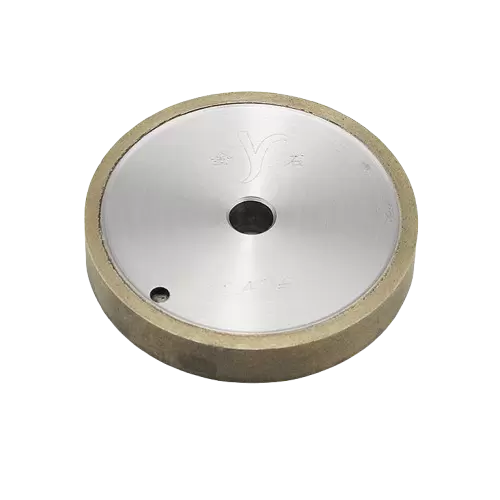
The glass grinding wheel service life is influenced by both the construction of the wheel and the conditions under which it is used. Two wheels with similar dimensions can perform very differently if their abrasive characteristics, bond system, or application conditions are not properly matched.
For industrial glass processing, service life should be evaluated through several indicators: the amount of glass processed, edge quality, profile retention, grinding efficiency, and the frequency of wheel replacement.
Diamond is widely used for precision glass grinding because of its high hardness and wear resistance. However, simply selecting a diamond wheel does not guarantee long service life.
The diamond grit size, abrasive quality, concentration, and distribution all affect how the wheel behaves during processing. Coarser diamond particles can provide strong material removal, while finer particles are generally more suitable when surface finish and edge quality are priorities.
The relationship between grit size and wheel life is not always straightforward. An abrasive that is too coarse for a particular process may experience excessive impact, while an abrasive that is too fine may require higher grinding force and become less efficient.
This is why diamond grit size should be selected according to the glass type, thickness, required edge finish, machine configuration, and grinding conditions.
For a more detailed discussion of grit selection, see How to Choose the Right Diamond Grit Size for Glass Grinding.
The bond holds diamond particles in the working layer and determines how quickly worn abrasive particles are released and new cutting edges become available.
A bond that holds the diamond too weakly may lead to premature abrasive loss. A bond that is excessively strong may prevent worn particles from being released efficiently, reducing wheel sharpness and increasing grinding force.
The right balance between abrasive retention and self-sharpening is therefore essential to controlling grinding wheel wear.
Different glass applications may require different bond characteristics. High-volume photovoltaic glass processing, automotive glass edging, and appliance glass grinding do not necessarily place the same demands on a wheel.
For precision glass processing, usable life also depends on whether the wheel can maintain its intended profile.
A wheel may still have sufficient abrasive material but become unsuitable if its working geometry changes significantly. Profile deviation can affect edge dimensions, bevel geometry, corner quality, and the consistency of the finished glass.
This makes profile retention an important part of service life.
In other words, a longer-lasting grinding wheel is not simply one that wears slowly. It should continue to produce acceptable results throughout its useful operating period.
Premature wear usually results from a mismatch between the wheel, machine, material, and processing parameters rather than from one isolated problem.
Common causes include:
These factors can also interact. For example, a wheel that is appropriate for a certain glass thickness may wear much faster if the feed rate is increased significantly without adjusting other process parameters.
Excessive pressure is another common problem. When the mechanical load on individual diamond particles becomes too high, abrasive fracture and bond wear can accelerate. The result may be higher wheel consumption without a corresponding increase in productive output.
The first step in solving premature wear is therefore to identify whether the problem comes from wheel selection, machine conditions, or processing parameters.
Extending wheel life starts before the wheel reaches the production line. Choosing a suitable wheel based only on diameter or price can create problems later.
A proper selection considers the material being processed, glass thickness, required edge geometry, machine type, operating speed, and desired surface finish.
For a broader range of application-specific options, manufacturers can review Glass Processing Grinding Wheels according to the processing requirements.
Grit size should correspond to the amount of material that needs to be removed and the quality of the finished edge.
Coarser grits are generally associated with more aggressive material removal, while finer grits are commonly used when a smoother finish and greater control are required.
However, choosing the coarsest possible abrasive simply to increase production speed is not always effective. Excessive abrasive impact can increase wear, while an unsuitable grit may create more edge defects and require additional finishing.
A better approach is to select the smallest practical grit range that provides the required balance between material removal, edge quality, and wheel consumption.
Bond selection should reflect the operating conditions of the wheel.
A high-volume production line may require a different balance of sharpness and abrasive retention than a precision application where dimensional stability is more important.
The right bond can help the wheel maintain an effective cutting surface without excessive abrasive loss. It also influences how the wheel responds as individual diamond particles become worn.
For this reason, grinding wheel bond should be considered together with grit size rather than treated as an independent specification.
Wheel dimensions must match the equipment and processing system. Outer diameter, inner diameter, profile, mounting configuration, and working width can all affect performance.
The glass itself also matters. A wheel designed for thin display glass may not be appropriate for a heavier automotive glass application, even when the general grinding principle is similar.
A properly matched specification reduces unnecessary mechanical loading and helps maintain stable contact between the wheel and glass.
Even a high-quality wheel can experience premature wear if the grinding parameters are poorly controlled.
The goal is not necessarily to operate at the lowest possible speed or pressure. Instead, the production line should operate within a stable processing range where material removal, heat generation, wheel wear, and edge quality remain balanced.
| Parameter | Potential Effect on Wheel Life | Optimization Direction |
|---|---|---|
| Grinding speed | Excessive speed can increase heat and wear | Match speed to wheel and machine |
| Feed rate | High feed can increase mechanical loading | Maintain a stable feed rate |
| Grinding pressure | Excessive pressure accelerates abrasive wear | Avoid unnecessary loading |
| Grinding depth | Heavy stock removal increases wheel load | Use an appropriate removal rate |
| Coolant flow | Poor cooling can increase thermal stress | Maintain adequate coolant supply |
Grinding speed has a direct relationship with heat generation and wheel behavior.
Increasing speed may improve productivity in a suitable system, but higher speed does not automatically mean higher efficiency. If heat generation increases faster than the cooling system can remove it, abrasive and bond wear may accelerate.
The correct speed depends on the wheel design, machine, glass specification, and coolant conditions.
Rather than changing speed aggressively, manufacturers should establish a stable operating range and monitor edge quality and wheel consumption.
Feed rate determines how quickly the glass moves through the grinding process, while grinding pressure influences the load placed on the wheel.
A higher feed rate can improve output, but excessive feed can increase the force required to remove material. Similarly, excessive pressure may cause accelerated diamond wear without producing proportional productivity gains.
Stable processing is generally more valuable than simply pushing one parameter to its maximum.
If increasing feed rate causes a noticeable deterioration in edge quality or a sharp increase in grinding wheel wear, the process may have moved beyond its economical operating range.
The amount of material removed in each grinding operation also affects wheel loading.
Heavy stock removal increases the amount of work performed by the abrasive layer and can generate more heat. Where process conditions allow, controlling the grinding depth can help distribute the workload more evenly.
For automated production lines, stable material allowance is also important. Large variations in incoming glass dimensions can create inconsistent loads and make wheel wear more difficult to control.
Cooling is often treated as a way to protect the glass, but it also plays an important role in glass grinding wheel wear.
Grinding generates heat through friction and material removal. If that heat is not removed effectively, thermal conditions can affect both the workpiece and the grinding wheel.
Insufficient coolant flow can contribute to higher wheel temperature, unstable grinding behavior, surface defects, and accelerated wear. Poorly directed coolant can create a similar problem even when the total coolant supply appears sufficient.
The coolant system should therefore provide consistent coverage of the grinding zone. Flow direction, nozzle position, cleanliness, and circulation should all be checked as part of routine process maintenance.
The objective is not simply to use more coolant. It is to ensure that the grinding zone receives sufficient and consistent cooling under actual production conditions.
Grinding wheel performance cannot be separated from machine condition.
A properly designed wheel may wear unevenly if the spindle, mounting system, or machine structure introduces vibration or misalignment. This can create localized loading and prevent the abrasive layer from working evenly.
Excessive vibration can lead to inconsistent contact between the wheel and glass. Instead of producing a stable grinding action, the wheel may experience repeated impact or fluctuating loads.
Typical consequences include uneven wear, rougher edges, increased noise, and reduced process consistency.
When unusual wheel wear appears suddenly, checking the machine should be part of the troubleshooting process rather than immediately changing the wheel specification.
Incorrect mounting can cause the wheel to run outside its intended position.
The mounting surface should be clean and properly seated, while the wheel should be installed according to the equipment manufacturer's requirements. Any significant runout should be investigated before continuing production.
Alignment becomes particularly important when the application requires consistent edge geometry over long production runs.
For high-speed applications, dynamic balance can have a significant influence on operating stability.
An appropriately balanced wheel reduces unnecessary vibration and supports more consistent contact with the workpiece. This can help protect both the wheel and the finished glass.
Machine stability is therefore part of the overall strategy for extending diamond grinding wheel life, especially in automated and high-speed glass processing.
Wheel replacement should not be based solely on a fixed operating time.
Production teams should monitor both the wheel and the processed glass. Changes in edge quality often provide an early indication that the grinding system is moving away from its normal operating condition.
Signs that a wheel may require attention include:
These symptoms do not always mean the wheel itself is defective. They may also indicate problems with coolant, machine alignment, glass variation, or grinding parameters.
For this reason, monitoring should consider the entire process.
A wheel that is replaced too early increases tooling costs. A wheel that is used for too long may cause defective glass, additional rework, or unexpected production downtime.
The economical replacement point is therefore the point at which continued use no longer provides stable processing value.
For industrial buyers, the purchase price of a grinding wheel is only one part of its actual cost.
A wheel with a lower initial price may require frequent replacement or create more process interruptions. Another wheel with a higher initial cost may process considerably more glass while maintaining stable quality.
The more useful metric is often the overall cost associated with wheel consumption.
This can include:
For example, a wheel that lasts longer but maintains acceptable edge quality can reduce the number of replacements required during a production cycle. Fewer replacements also mean less interruption to automated equipment.
This is particularly important for high-volume glass processing. Even a small reduction in wheel replacement frequency can have a meaningful effect when multiplied across many machines and long production runs.
For this reason, manufacturers should evaluate wheel replacement frequency, processed meters, edge quality, and downtime together rather than comparing purchase prices alone.
Different glass applications place different demands on a grinding wheel.
Photovoltaic glass production emphasizes high throughput and consistent edge quality. Automotive glass requires reliable profile retention and compatibility with specific edging equipment. Appliance glass processing may require a combination of high material removal, precision, and long operating life.
Application-specific wheel design can address these differences more effectively than a one-size-fits-all approach.
Photovoltaic glass is processed in high-volume manufacturing environments where wheel consumption can have a direct impact on production costs.
A PV Glass Grinding Wheel is designed around the requirements of photovoltaic glass edge processing, with emphasis on high grinding efficiency, wear resistance, and consistent edge quality.
For suitable production conditions, the Meijie PV glass grinding wheel can provide a typical service life of more than 50,000 meters per set, with certain applicable configurations exceeding 60,000 meters per slot.
Its specifications can also be adapted to different equipment and glass thicknesses, making it suitable for production lines that require both high throughput and stable processing.
Automotive glass often requires precise edge processing and stable geometry. The wheel must maintain its working profile while providing sufficient sharpness for efficient grinding.
An Automotive Glass Grinding Wheel can be designed around the specific requirements of automotive glass and the edging equipment used on the production line.
Meijie's automotive glass grinding wheel uses diamond abrasive with an M-type bond and focuses on sharpness, wear resistance, and shape retention. OEM customization is also available where different equipment models or processing conditions require specific wheel dimensions or profiles.
This application-specific approach can help reduce unnecessary wear caused by an unsuitable wheel configuration.
Appliance glass processing covers a range of products and machining requirements, so wheel stability and versatility are important.
An Appliance Glass Grinding Wheel is designed for CNC machining centers and glass edging applications, with diamond abrasive and a bronze alloy bond.
The wheel is manufactured using vacuum hot-press sintering and is designed to provide sharp grinding performance, profile retention, and long service life. Under suitable processing conditions, its service life can exceed 20,000 meters.
For production environments where consistent grinding performance matters as much as initial tooling cost, these characteristics can contribute to a lower overall consumption rate.
There is no single adjustment that can guarantee maximum wheel life. The most reliable results come from managing several factors as one process.
A practical strategy is to:
This approach is especially useful when a production line is experiencing frequent wheel replacement. Instead of immediately switching to another wheel, manufacturers can identify whether the root cause is related to selection, process settings, cooling, or machine condition.
Extending the service life of glass grinding wheels is ultimately a process-control issue rather than a simple matter of choosing a harder or more expensive wheel.
A suitable combination of diamond abrasive, bond, wheel profile, grinding parameters, cooling, and machine stability allows the wheel to maintain its working characteristics for longer. At the same time, regular monitoring helps prevent excessive wear from turning into edge defects or production downtime.
For glass processors, the best wheel is therefore not necessarily the one with the lowest purchase price or the longest theoretical life. It is the one that maintains reliable grinding performance, acceptable edge quality, and predictable consumption throughout the production cycle.