
Aug 06,2026
What Is a Diamond Grinding Wheel and How Does It Work?
High-volume glass processing puts continuous pressure on every part of a production line. When thousands of glass panels pass through edging and grinding equipment each day, even a small loss in grinding efficiency can result in longer cycle times, more frequent wheel changes, higher abrasive consumption, and inconsistent edge quality.
For manufacturers processing photovoltaic, automotive, home appliance, and other industrial glass products, improving grinding efficiency is therefore not simply a matter of increasing machine speed. The glass grinding wheel, grinding parameters, coolant conditions, machine stability, glass characteristics, and wheel maintenance all have to work together.
The right approach is to increase material removal efficiency while keeping chipping, overheating, vibration, and wheel wear under control. This article examines the main factors affecting grinding efficiency and explains practical ways to improve performance in high-volume glass processing.
Grinding efficiency is often associated with processing speed, but production efficiency is a broader concept. A grinding operation may run at a high feed rate while still producing poor overall results if the wheel wears rapidly or requires frequent dressing and replacement.
In industrial glass processing, efficiency can be evaluated through several related indicators:
A useful way to think about grinding efficiency is the amount of qualified glass processed per unit of production time and abrasive cost. This is particularly important for high-volume lines, where a small improvement in each processing cycle can produce a meaningful annual gain.
For this reason, selecting a suitable glass processing grinding wheel should be based on the complete production process rather than on maximum grinding speed alone.
A low-volume workshop can often compensate for process variations through manual adjustment. High-volume production has much less tolerance for this approach.
Continuous grinding exposes the wheel and machine to sustained mechanical and thermal loads. As production continues, changes in wheel profile, diamond exposure, coolant conditions, machine vibration, and glass positioning can gradually affect the finished edge.
The situation becomes even more demanding when production lines process different glass thicknesses, sizes, or edge profiles.
For example, photovoltaic glass processing often requires stable edge quality at relatively high feed rates. Automotive glass may require more specialized edge profiles and equipment compatibility, while home appliance glass can involve different thicknesses and dimensional requirements.
The objective is therefore not simply to make the wheel cut faster. The objective is to establish a grinding system in which the wheel can maintain its cutting ability and geometry throughout a long production cycle.
The grinding wheel is one of the most important variables in the process. A wheel designed for one glass application may not deliver the same performance on another material or production line.
Diamond abrasive is widely used for glass grinding because of its high hardness and ability to maintain effective cutting performance. However, diamond quality alone does not determine wheel performance. Bond type, grit size, concentration, wheel profile, dimensions, and manufacturing process all influence the final result.
For example, a PV glass grinding wheel designed for photovoltaic glass may need to balance high feed rates, low chipping, profile stability, and long service life. A wheel used for automotive glass may require a different geometry or specification according to the edging equipment and glass profile.
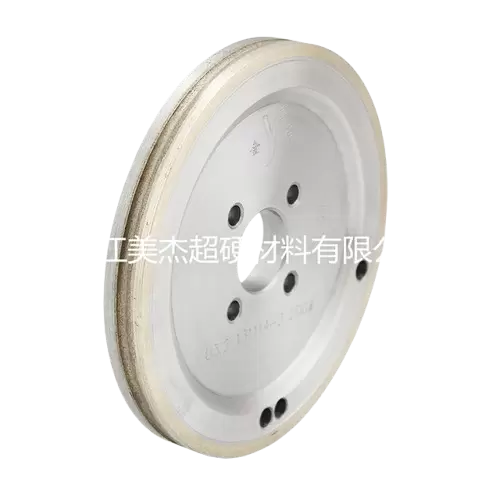
Meijie's PV Glass Grinding Wheel is designed for photovoltaic glass edge processing and supports glass thicknesses from 2 to 18 mm, with grit sizes ranging from 80# to 400#. Its application-specific design makes it more suitable for production lines where both throughput and edge quality are important.
Similarly, a home appliance edge grinding wheel can be configured for CNC machining centers and different glass edging machines, with specifications designed around the requirements of high-efficiency edge processing.
The key point is that wheel selection should start with the application, machine, and processing target rather than with a generic wheel specification.
Diamond grit size has a direct influence on material removal, edge finish, and grinding behavior.
Coarser diamond grit generally provides stronger cutting action and higher material removal capability. It can be useful when a larger amount of material must be removed efficiently. Finer grit, by comparison, is more appropriate when surface finish and edge quality become the primary concern.
This does not mean that a coarse grit wheel is always more efficient. If the resulting edge requires additional finishing or creates excessive chipping, the apparent gain in grinding speed can be offset by downstream processing.
A practical production line may therefore use different grit sizes for different grinding stages. Rough grinding can focus on material removal, while subsequent grinding or polishing stages progressively improve the finished edge.
For manufacturers evaluating grit selection in more detail, diamond grit size for glass grinding should be considered together with glass thickness, wheel bond, feed rate, spindle speed, and required edge quality.
Feed rate is one of the most visible grinding parameters, but increasing it without considering wheel capacity can quickly create new problems.
When the feed rate increases, the wheel must remove more material in less time. If the wheel has sufficient cutting ability and the machine remains stable, productivity can increase. If the grinding system is pushed beyond its practical operating range, however, wheel loading, chipping, vibration, and heat generation may increase.
The ideal feed rate depends on several variables:
High-volume production should therefore aim for the optimal feed rate, not simply the highest possible feed rate.
A stable feed rate that produces consistent edges for an entire production shift is often more valuable than a higher setting that creates frequent quality problems.
Grinding depth determines how much material the wheel removes during each pass. Excessive grinding depth increases the load on the abrasive and machine, while an unnecessarily shallow depth may reduce production efficiency.
For automated glass processing, grinding depth should correspond to the amount of edge material that actually needs to be removed.
If the process requires substantial stock removal, it may be more effective to distribute the material removal across multiple grinding stages rather than forcing a single wheel to remove everything at once.
This approach can help control:
The best setting is determined through production trials and should be evaluated together with feed rate and spindle speed.
Spindle speed affects the cutting behavior of a diamond grinding wheel. However, spindle RPM alone does not provide enough information because the actual wheel surface speed also depends on wheel diameter.
When the wheel diameter changes, the surface speed changes even if the spindle RPM remains constant. This is one reason why grinding parameters should be evaluated as a complete set rather than adjusted individually.
For high-volume production, spindle speed should be selected according to the wheel manufacturer's recommended operating range and the characteristics of the equipment.
An excessive speed setting can contribute to heat, vibration, and abrasive wear. Too low a speed may reduce cutting efficiency and increase the load on individual diamond particles.
The objective is a balanced cutting condition in which the abrasive remains active without placing unnecessary stress on the wheel.
Glass grinding generates heat at the contact zone between the wheel and workpiece. Effective coolant management helps control this heat and also assists in removing glass particles from the grinding area.
In continuous production, coolant quality can gradually change. Contamination, inadequate flow, blocked nozzles, or incorrect positioning can reduce cooling performance.
For this reason, coolant should not be treated as a secondary issue.
The coolant system should provide sufficient flow directly to the grinding contact area. Nozzles should be positioned so that coolant reaches the actual grinding zone rather than being deflected away by the rotating wheel.
Water quality and filtration also matter. Accumulated glass particles can circulate through the system and affect both processing stability and equipment condition.
A stable coolant system can contribute to more consistent edge quality and reduce the risk of thermal damage during long production runs.
Vibration is another major obstacle to efficient glass grinding.
Glass is sensitive to localized mechanical stress. When vibration occurs during grinding, the contact between the wheel and glass becomes less stable. This can contribute to uneven edges, increased chipping, premature wheel wear, and poor surface finish.
Wheel balancing is particularly important for high-speed grinding. Even a small imbalance can become more noticeable as rotational speed increases.
Machine rigidity should also be considered. Loose fixtures, worn bearings, unstable workholding systems, or misalignment can introduce vibration that cannot be solved simply by changing the grinding wheel.
Before increasing grinding parameters, manufacturers should therefore verify the mechanical condition of the complete system.
A grinding wheel does not perform only through its abrasive characteristics. Its geometry must remain accurate throughout the process.
Profile grinding is especially sensitive to dimensional changes. As the wheel wears, its effective profile may gradually change. If this change is not controlled, the resulting glass edge may no longer meet the required dimensions.
A wheel with good profile retention can reduce the frequency of corrections and help maintain consistent production.
This is one reason why bond selection matters. Different bond systems provide different combinations of cutting sharpness, wear resistance, and form retention.
For demanding applications, manufacturers may choose diamond profile grinding wheels or specially shaped wheels according to the required glass edge geometry.
The correct profile should be matched to the edging machine and the final glass specification.
Wheel replacement creates direct downtime. In a high-volume production environment, however, the actual cost can be greater than the replacement price itself.
A wheel change may involve stopping the machine, removing the existing wheel, installing the new one, checking alignment, balancing the system, and restarting production. Additional adjustment may be required before the line returns to stable output.
This makes wheel life an important part of production efficiency.
A longer-lasting wheel is not automatically the best choice, because excessive wear resistance can sometimes reduce cutting sharpness. The more useful target is a balanced wheel that provides adequate sharpness while maintaining predictable wear.
Meijie's automotive glass grinding wheel, for example, combines diamond abrasive with an M-type binder to provide sharpness, shape retention, and a high grinding ratio. Its design is intended for demanding automotive glass processing applications where consistent performance over extended production periods is important.
Waiting until the grinding wheel produces visibly poor edges is not an efficient maintenance strategy.
Wheel wear can often be identified through changes in grinding behavior. Increasing spindle load, changes in grinding sound, greater vibration, reduced material removal, or gradual deterioration in edge quality can all indicate that the wheel condition needs attention.
Production teams can establish practical monitoring points based on their own equipment.
For example, operators can record wheel consumption, processed glass length, edge quality, and replacement intervals. Over time, these records provide a clearer picture of actual wheel performance.
This information can also help determine whether a change in wheel specification is genuinely improving productivity.
High-volume production depends on repeatability. A grinding wheel cannot compensate for poorly maintained equipment.
Regular maintenance should cover the wheel mounting system, spindle, bearings, coolant system, fixtures, and other components that directly influence grinding stability.
A simple maintenance routine can help prevent small mechanical problems from becoming production interruptions.
Key areas include:
Maintenance intervals should be based on actual production conditions. A machine operating continuously at high feed rates may require more frequent inspection than equipment used intermittently.
Grinding parameters should never be considered independently of the wheel.
For example, changing from a coarse-grit wheel to a fine-grit wheel changes the cutting behavior. Increasing feed rate changes the load on the abrasive. Increasing spindle speed changes wheel surface speed. Altering grinding depth changes the amount of material removed per pass.
Each adjustment can affect the others.
| Grinding factor | Main influence | Potential issue when excessive |
|---|---|---|
| Feed rate | Production throughput | Higher load and chipping |
| Grinding depth | Material removal | Excessive wheel load |
| Spindle speed | Cutting conditions | Heat or vibration |
| Grit size | Cutting and finish | Poor finish or low removal rate |
| Coolant flow | Heat and debris control | Thermal instability |
This is why process optimization should be performed systematically rather than by making several changes simultaneously.
A controlled trial makes it easier to identify which parameter actually improves performance.
Different glass industries have different priorities.
Photovoltaic glass production emphasizes high throughput and stable edge quality. Large production volumes make wheel life and processing speed particularly important.
A properly specified photovoltaic glass grinding wheel can support high-speed edge processing while maintaining dimensional stability. Meijie's PV grinding wheel, for example, is designed for edge grinding speeds of approximately 10–18 meters per minute in applicable production conditions and offers multiple grit and profile options.
The correct wheel should still be selected according to the actual machine, glass thickness, edge geometry, and process requirements.
Automotive glass can involve curved shapes, specific edge profiles, and demanding dimensional requirements. Grinding consistency is therefore important not only for appearance but also for downstream assembly.
An automotive glass grinding wheel with appropriate profile retention and equipment compatibility can help maintain stable edge processing during long production runs.
The wheel specification should be matched to the edging machine rather than selected only according to nominal wheel dimensions.
Home appliance glass often requires a clean, consistent edge appearance combined with efficient production. CNC machining centers and automated edging equipment place additional emphasis on dimensional stability and repeatability.
A home appliance edge grinding wheel designed for the relevant glass thickness, machine, and grinding stage can help maintain consistent output while reducing unnecessary wheel replacement.
Improving grinding efficiency does not necessarily require a major change to the entire production line. In many cases, meaningful gains come from correcting several smaller factors.
Start by measuring the current process. Record feed rate, spindle speed, grinding depth, wheel life, processed glass length, edge quality, and downtime associated with wheel changes.
Next, identify the largest source of inefficiency. If wheel replacement is frequent, focus on wheel specification and wear. If edge chipping is the main issue, review grit size, feed rate, grinding depth, and coolant conditions. If production speed is limited, examine whether the wheel and machine can safely support a higher feed rate.
Only after the baseline is clear should production parameters be changed.
A practical optimization cycle can follow this sequence:
Measure → identify the limiting factor → adjust one variable → evaluate results → standardize the improved setting.
This approach reduces unnecessary trial and error and creates a more reliable basis for production decisions.
It can be tempting to evaluate a grinding wheel by asking how fast it can process glass. For high-volume production, that is only part of the equation.
Suppose a wheel operates at a high feed rate but must be replaced frequently because of rapid wear. The production line may lose more time during wheel changes than it gains from faster grinding.
The same principle applies to edge quality. If higher grinding speed creates additional chipping and requires rework or secondary processing, the actual production efficiency may decline.
A more useful target is stable high productivity.
That means maintaining a reasonable balance between processing speed, wheel life, edge quality, machine stability, and maintenance requirements.
Improving efficiency in high-volume glass processing is a process optimization task rather than a single parameter adjustment. The glass grinding wheel, feed rate, grinding depth, spindle speed, coolant, machine condition, and wheel maintenance all influence the final result.
For manufacturers, the most practical strategy is to establish a stable baseline, identify the main production constraint, and then optimize the relevant variables one at a time. Application-specific wheel selection is equally important, particularly when processing photovoltaic, automotive, or home appliance glass.
A well-matched grinding wheel combined with controlled processing parameters can deliver more consistent edges, longer wheel life, fewer interruptions, and better overall production economics.