
Sep 11,2026
What Causes Surface Damage During Wafer Grinding?
Consumer electronics glass is used in a growing range of products, including smartphones, tablets, smartwatches, and virtual reality devices. Beyond flat edges and standard rectangular shapes, many components require more complex contours, such as notches, waterdrop profiles, and home button openings. These areas place additional demands on glass grinding because the tool must follow the intended geometry while maintaining consistent edge quality and dimensional accuracy.
Choosing a suitable diamond grinding wheel for consumer electronics glass requires more than checking the wheel diameter or abrasive grit. The profile being processed, workpiece thickness, machine configuration, tool positioning, and grinding conditions all influence the result. A wheel that performs well on a straight edge may not be the right choice for a small or curved profile.
This guide examines the grinding requirements of three common consumer electronics glass profiles, discusses practical processing challenges, and explains the main factors to consider when selecting an electronic glass grinding wheel. It also introduces relevant tool specifications for manufacturers working with precision-shaped glass components.
Notch, waterdrop, and home button profiles differ in geometry and processing requirements. Their differences affect how the grinding tool approaches the workpiece, follows the contour, and maintains contact during material removal.
Understanding the profile before selecting a grinding wheel helps manufacturers assess tool dimensions, groove structure, abrasive grit, and equipment compatibility.
A notch is a localized cut-out along the edge of a glass component. It may be required to accommodate structural features or create space for other components within an electronic device. Unlike a straight edge, a notch introduces changes in direction and localized geometry that require careful control during grinding.
The transition between the main edge and the recessed section deserves particular attention. If the tool path does not match the intended profile, the finished contour may show dimensional variation or irregular transitions. Small contact areas can also make the process more sensitive to tool positioning and equipment stability.
For notch screen glass grinding, manufacturers should consider the notch dimensions, corner geometry, glass thickness, and the equipment's ability to maintain a consistent grinding path. The selected wheel must also be compatible with the machine's mounting arrangement and operating conditions.
The objective is not simply to remove material from the notch. The finished profile must remain consistent with the component drawing while meeting the required edge-quality standards.
Waterdrop profiles generally involve a curved or tapered contour rather than a simple straight edge. This geometry requires the grinding tool to follow a controlled path through changing directions and transitions.
During waterdrop screen glass processing, the relationship between the tool geometry and the workpiece contour is important. A suitable grinding wheel needs to accommodate the intended profile without creating uneven transitions between adjacent sections.
Surface finish and contour consistency should be evaluated together. A profile may appear visually smooth but still show dimensional differences, while an accurate contour may require additional attention to edge finish. Both aspects should be considered during tool selection and process evaluation.
Manufacturers should review the actual profile drawing and processing method before choosing a wheel. The curve radius, glass thickness, machine configuration, and required finish all influence the selection.
Home button glass components involve localized features that may occupy a relatively small area of the workpiece. Their processing can require tools with suitable dimensions and a stable positioning arrangement, particularly when the profile includes circular or curved sections.
For home button glass grinding, wheel diameter and shank size are important because they need to match the machine setup and the size of the processing area. The tool must also be suitable for the required contour and the material removal conditions.
Small-profile processing can be sensitive to variations in positioning, tool condition, and machine operation. Manufacturers should therefore assess not only the grinding wheel itself but also the consistency of the overall process.
| Glass Profile | Profile Characteristics | Key Grinding Considerations |
|---|---|---|
| Notch | Localized cut-out or recessed contour | Corner quality, edge chipping, dimensional accuracy |
| Waterdrop | Curved or tapered contour | Smooth transitions, contour consistency, edge finish |
| Home Button | Small, localized profile | Tool dimensions, positioning stability, dimensional control |
Although these profiles have different geometries, they share several practical requirements: a suitable tool size, stable equipment operation, controlled material removal, and consistent inspection standards.
Complex glass profiles require attention to more than the final shape. Edge condition, surface appearance, dimensional accuracy, and process stability can all affect whether a component meets its production requirements.
The following issues are worth considering when evaluating a grinding process.
Edge chipping is a common concern in glass grinding, particularly around localized features and changes in contour. Notch corners and small-radius sections may require more careful control than long, straight edges.
Several factors can contribute to chipping:
Abrasive and wheel condition: An unsuitable abrasive specification or a worn grinding surface may affect the material removal process.
Grinding conditions: Feed rate, grinding depth, and machine speed need to be appropriate for the workpiece and tool.
Workpiece support: Inadequate support or movement during processing may contribute to inconsistent contact.
Profile geometry: Sharp transitions and small processing areas may require a more carefully controlled tool path.
These factors should be evaluated together rather than treating chipping as the result of a single parameter. When a defect appears repeatedly in one section of a profile, manufacturers should compare the actual tool path and processing conditions with the workpiece geometry.
Scratches and variations in surface finish can affect the appearance and quality of consumer electronics glass. Their causes may include abrasive condition, contamination, debris remaining in the grinding area, or inconsistencies in the processing setup.
Chip removal is particularly relevant because grinding debris can remain around the contact area if the process does not provide adequate evacuation. The condition of the wheel and the effectiveness of cooling and cleaning arrangements should therefore be reviewed when surface defects occur.
Abrasive grit selection also matters. Different grit sizes produce different material-removal characteristics and surface conditions. Manufacturers should match the grit to the processing stage and required finish rather than selecting a specification based on grit number alone.
Grinding generates heat through contact between the abrasive tool and the glass. If heat is not managed appropriately, it may affect process stability and contribute to quality concerns.
Cooling conditions and chip evacuation should be considered during equipment setup. The wheel's structure can also influence how effectively debris leaves the grinding area. A dense and uniform tooth structure, for example, is relevant to the cooling and chip-removal characteristics described for certain consumer electronics grinding wheels.
The practical objective is to maintain suitable processing conditions throughout the grinding cycle. Tool structure, machine configuration, cooling arrangements, and operating parameters should be assessed as part of the same process.
A finished profile must correspond to the required dimensions and geometry. Variations may result from tool positioning, wheel dimensions, machine stability, tool wear, or differences in processing conditions.
For small or curved glass profiles, even relatively limited deviations may affect whether the component meets its drawing requirements. Manufacturers should check the relationship between the grinding wheel's dimensions and the machine's mounting and positioning system.
Inspection should also cover the complete profile rather than focusing only on one edge section. This helps identify whether a dimensional issue is localized or associated with the broader processing setup.
The selection of a diamond grinding wheel for consumer electronics glass should begin with the workpiece and the machine, not with a single product specification. Wheel diameter, shank size, groove structure, grit range, and operating conditions all need to be considered in relation to the intended profile.
Wheel diameter affects the tool's suitability for the processing area and the machine configuration. Small or localized contours may require a compact grinding tool, while the mounting dimensions must match the equipment.
For the consumer electronics glass grinding wheel discussed in this guide, the available specifications include:
Wheel diameter: Ø5–Ø15 mm
Shank diameter: Ø6 mm or Ø10 mm
These dimensions provide options for different equipment arrangements and processing requirements. However, the smallest available diameter is not automatically the best choice for every profile. Manufacturers should check the workpiece geometry, required contact area, machine clearance, and mounting compatibility before confirming a specification.
The shank diameter must also match the machine's holding system. A mismatch can prevent proper installation or affect the stability of the tool setup.
Groove structure is another consideration when selecting a precision glass grinding head. The product specifications include three groove options: Trapezoidal, U-shaped, and Grooveless.
These structures provide different tool configurations, but their suitability should be assessed against the actual workpiece drawing and processing method. A groove name alone does not establish that the wheel is suitable for a particular notch, waterdrop, or home button profile.
When comparing options, manufacturers should review the required contour, tool contact conditions, equipment arrangement, and expected grinding result. Where necessary, trial processing can help determine whether the selected structure is appropriate for the intended application.
It is also important to confirm that the wheel can be installed and operated correctly on the target machine. Compatibility should be checked before production rather than assumed from the tool's external dimensions.
Grit selection influences the material-removal characteristics of a grinding wheel and the surface condition produced during processing. A manufacturing process may involve different requirements during rough and finish grinding, so one grit specification may not be suitable for every stage.
The product's stated grit range is 400#–1200#. The appropriate choice depends on the workpiece, the processing stage, the required surface finish, and the machine conditions.
A practical selection process should consider:
The amount of material that needs to be removed.
The required edge and surface condition.
The geometry of the glass profile.
The relationship between rough grinding and subsequent finishing operations.
A finer grit should not be selected solely on the assumption that it will improve every aspect of production. The final choice needs to balance material removal, processing efficiency, and the required quality level.
Abrasive quality and bond formulation influence the working characteristics of a diamond grinding wheel. Sharpness is relevant to material removal, while wheel structure and chip evacuation are important considerations for managing the grinding contact area.
For complex glass profiles, manufacturers should also assess whether the tool is compatible with the machine used in production. The consumer electronics grinding wheel covered here is described as compatible with double edging machines of different brands. Its stated product features include high-quality diamond abrasive, an exclusive formulation, and a dense, uniform tooth structure intended to support cooling and chip discharge.
These characteristics are relevant when comparing an electronic glass grinding wheel for precision contour processing. The final selection should still be confirmed against the actual machine, workpiece, and production conditions.
| Product Parameter | Available Specification |
|---|---|
| Wheel Diameter | Ø5–Ø15 mm |
| Shank Diameter | Ø6 mm / Ø10 mm |
| Groove Type | Trapezoidal / U-shaped / Grooveless |
| Grit Range | 400#–1200# |
| Workpiece Thickness | 0.15T, 0.2T and other LCD panel thicknesses |
| Equipment Speed | 24,000–45,000 r/min |
| Feed Rate | 150–600 mm/min |
| Grinding Depth | 0.1–5 mm, divided into rough and finish grinding |
The listed values are product-related specification ranges, not universal operating recommendations. Actual settings should be determined according to the workpiece, equipment, selected wheel, and processing requirements.
Selecting a suitable grinding wheel is only one part of the production process. Consistent results also depend on how the tool is installed, how operating conditions are matched to the workpiece, and how the finished profile is inspected.
Grinding parameters should be evaluated in relation to the glass thickness, profile geometry, tool dimensions, and machine capability. The same settings should not automatically be applied to different workpieces simply because they use the same wheel.
For example, the product specifications list equipment speeds of 24,000–45,000 r/min, feed rates of 150–600 mm/min, and grinding depths of 0.1–5 mm. The depth range is divided between rough and finish grinding. These figures provide a reference to the stated product range, but they should not be interpreted as settings suitable for every glass profile.
Manufacturers should establish process conditions through equipment checks and controlled trials. Any adjustment should be assessed against edge condition, profile dimensions, and surface quality.
Tool positioning and equipment stability are important when processing small or irregular contours. The grinding wheel should be installed correctly, and the machine setup should maintain the intended relationship between the tool and workpiece.
The product is equipped with RFID electronic tags as standard. According to the product information, this feature supports precise positioning and processing accuracy. It is a tool-identification and positioning-related feature; it should not be confused with automatic wear monitoring or real-time process control.
A stable setup also requires attention to tool condition, machine operation, workpiece positioning, and the consistency of the processing sequence.
Inspection should be based on the component drawing and the manufacturer's quality requirements. A useful inspection process can include:
Profile dimensions: Check whether the notch, curve, or localized contour matches the required geometry.
Edge condition: Examine the processed area for chipping, scratches, and irregular transitions.
Surface finish: Assess whether the finished edge meets the specified appearance and quality requirements.
If a defect appears, the inspection result should be considered alongside the tool condition, machine setup, and processing records. This makes it easier to identify possible sources of variation and determine whether tool selection or process conditions need adjustment.
For manufacturers processing notch screens, waterdrop screens, home keys, and other shaped electronic glass components, tool selection needs to reflect the actual contour and equipment requirements.
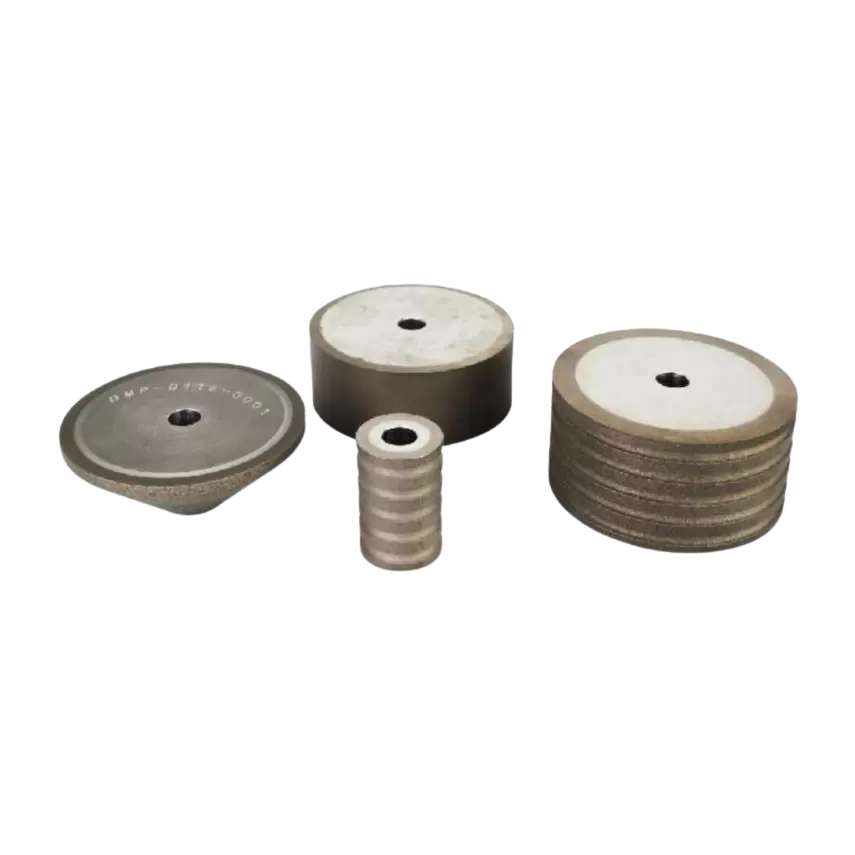
smart wearable consumer electronics grinding wheel is designed for precision special-shaped contour processing of electronic glass. Its stated applications include notch screens, Home keys, and waterdrop screens, as well as glass components used in mobile phones, tablets, smartwatches, and VR devices.
The product is available with wheel diameters from Ø5–Ø15 mm, Ø6 mm or Ø10 mm shanks, and Trapezoidal, U-shaped, or Grooveless groove options. Its grit range is 400#–1200#, providing different specifications for manufacturers to evaluate according to their processing stages and workpiece requirements.
The product information identifies several key features:
Superior sharpness: High-quality diamond abrasive and an exclusive formulation are intended to support efficient and smooth edging.
Heat dissipation and chip removal: A dense, uniform tooth structure supports cooling and debris discharge during grinding.
Compatibility and stability: The wheel is designed for compatibility with double edging machines from different brands.
RFID electronic tags: Standard RFID tags support precise positioning.
These features provide a basis for evaluating the wheel in consumer electronics glass processing. Manufacturers should confirm the appropriate dimensions, groove configuration, grit, and operating conditions against their own equipment and workpiece drawings before placing the tool into production.
Notch, waterdrop, and home button glass profiles each present different geometric requirements, but reliable grinding depends on several shared considerations: suitable tool dimensions, appropriate abrasive grit, compatible groove structure, stable positioning, and controlled processing conditions.
For manufacturers selecting a diamond grinding wheel for consumer electronics glass, the most useful starting point is the actual workpiece drawing and machine configuration. Product specifications can narrow the available options, while trial processing and inspection help confirm whether a selected wheel meets the required profile and edge-quality standards.
A careful approach to tool selection and process evaluation helps manufacturers make more informed decisions when processing complex electronic glass components.