
Aug 27,2026
What Is Wheel Bond and Why Does It Matter in Glass Grinding
Glass edge chipping is a common quality problem in precision glass processing. Small chips, micro-cracks, rough edges, and irregular profiles can appear when the grinding process is not properly matched to the glass material, grinding wheel, equipment, or processing parameters. For manufacturers processing photovoltaic, appliance, or automotive glass, these defects can affect edge quality, dimensional consistency, production yield, and rework rates.
The cause is not always the grinding wheel itself. Diamond grit size, wheel wear, wheel profile, grinding pressure, feed rate, grinding depth, machine vibration, wheel runout, and cooling conditions can all influence the result. A systematic approach to glass edge chipping therefore needs to consider the complete grinding process rather than a single parameter.
This guide explains the main causes of chipping during glass grinding, how to identify the source of the problem, and how to select a suitable glass grinding wheel for more stable edge processing.
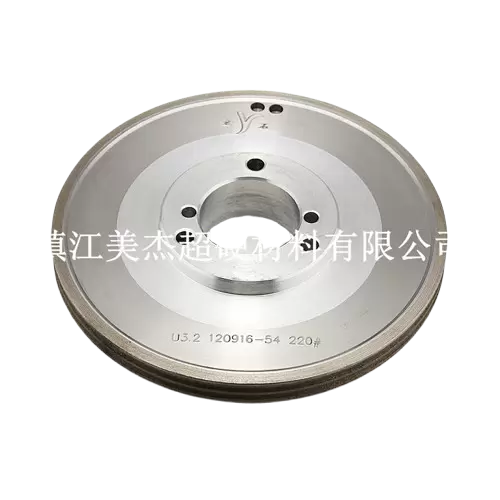
Glass chipping occurs when material breaks away from the edge instead of being removed in a controlled grinding process. Because glass is brittle, excessive mechanical stress can produce localized damage around the grinding area. The severity of the damage can range from small edge chips to visible cracks or an irregular edge profile.
Common signs of glass edge chipping include:
The location and appearance of the defect can provide useful clues. Chipping concentrated at particular sections of the edge may indicate an issue with wheel profile, machine alignment, or local grinding conditions. More consistent damage across the entire edge may point toward wheel specification, grit selection, feed rate, or grinding pressure.
For this reason, operators should not immediately assume that a defective glass grinding wheel is the only cause. The grinding wheel, machine, glass characteristics, and process parameters need to be considered together.
Glass chipping usually results from an imbalance between the grinding action and the strength of the glass edge. When abrasive cutting is too aggressive, unstable, or poorly matched to the application, the grinding force can cause unwanted fractures instead of producing a controlled edge.
The grinding wheel has a direct influence on how material is removed from the glass edge. A wheel needs to match the glass type, thickness, required edge geometry, processing equipment, and desired finish. Using an unsuitable wheel specification can make the grinding process less stable and increase the risk of edge defects.
A suitable glass grinding wheel should provide controlled abrasive action while maintaining its intended shape and cutting characteristics throughout the grinding cycle. Factors such as diamond grit size, bond characteristics, wheel profile, and wheel dimensions all affect how the abrasive interacts with the glass.
This is particularly important when different applications use significantly different processing conditions. High-volume photovoltaic glass grinding may prioritize stable high-speed processing and long wheel life, while automotive glass may require greater attention to edge profile and shape retention.
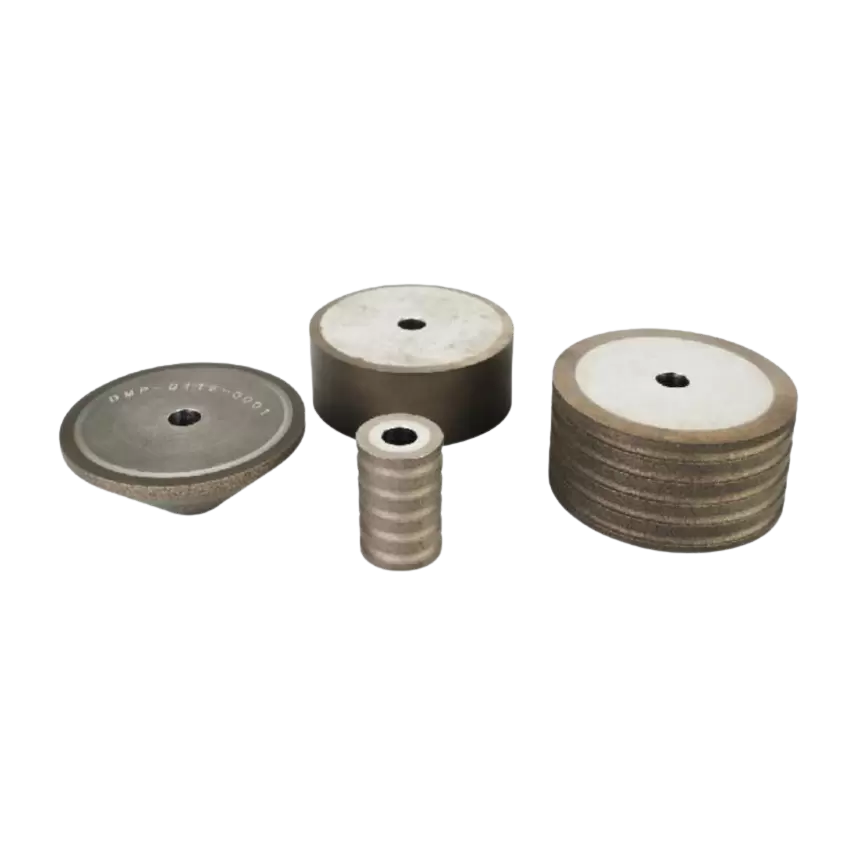
For different glass applications and equipment configurations, Meijie provides a range of Glass Processing Grinding Wheels covering PV glass, appliance glass, and automotive glass grinding requirements.
Diamond grit size affects the cutting behavior and surface finish produced by a grinding wheel. A grit specification that is too aggressive for the application may increase localized mechanical stress, while a specification that is too fine may not provide the required material removal efficiency.
The appropriate grit should therefore be considered together with glass thickness, edge geometry, required finish, grinding speed, and material removal requirements. It is not sufficient to select a grit based only on the desired surface appearance.
For example, production lines focused on high material removal may require a different abrasive specification from precision applications where edge finish and dimensional consistency are more important. The relationship between grit size and grinding performance is also closely connected to wheel condition and process parameters.
This is why diamond abrasive selection is an important part of diamond grinding wheel specification rather than an isolated purchasing decision.
Grinding pressure determines how strongly the abrasive contacts the glass surface. Excessive pressure can increase the mechanical load at the grinding interface and make the brittle glass edge more vulnerable to chipping.
When pressure is too high, the wheel may remove material more aggressively than the glass edge can withstand. This can become particularly noticeable when processing thin glass or when the grinding operation involves a relatively large amount of material removal.
Grinding pressure should therefore be controlled according to the wheel specification, glass thickness, grinding depth, feed rate, and equipment configuration. If chipping appears after a change in production speed or material removal requirements, grinding pressure should be considered as part of the troubleshooting process rather than treating the wheel as the only variable.
Feed rate and wheel speed influence how long the abrasive remains in contact with a particular section of the glass edge and how much material must be removed during each stage of the grinding process.
An excessively high feed rate can increase the load placed on the grinding wheel and glass edge. If the wheel specification or machine configuration cannot maintain stable grinding under the increased production rate, edge defects may become more noticeable.
At the same time, reducing the feed rate is not automatically the correct solution. Production efficiency, wheel characteristics, glass thickness, and the intended grinding result all need to be considered together. A stable process is one in which the grinding wheel can maintain consistent abrasive contact without creating excessive localized stress.
This balance is especially important in high-volume glass processing, where production lines need both efficient material removal and consistent edge quality.
Grinding depth determines how much material is removed during each pass. If the depth is excessive, the grinding wheel must remove more material at once, increasing the grinding load and the potential for localized stress.
The risk can become more significant when processing thicker glass, correcting a large edge allowance, or using a grinding process intended for heavy material removal. Instead of relying on a single aggressive grinding stage, the process may need to be adjusted to distribute material removal more consistently.
Grinding depth should therefore be considered alongside wheel sharpness, grit size, feed rate, and machine stability. If chipping increases after changing the amount of material removed per pass, grinding depth is an important parameter to investigate.
A grinding wheel does not maintain exactly the same condition throughout its service life. As abrasive performance changes, the wheel may require greater force to achieve the same grinding result. Wear can also affect the intended profile and dimensional stability of the wheel.
A worn wheel may produce inconsistent edge quality, particularly when the process requires a specific edge geometry. If chipping gradually becomes worse after extended production, rather than appearing immediately after installing a new wheel, wheel wear should be checked.
Wheel condition also needs to be considered together with service life. A longer-lasting wheel is valuable only when it can maintain stable grinding performance throughout its usable life. For precision applications, profile retention and consistent abrasive action can be as important as the total amount of glass processed before replacement.
The wheel profile must correspond to the edge geometry required by the glass product. If the profile does not properly match the intended edge, the contact between the wheel and glass can become unstable or uneven.
This is particularly relevant to automotive glass, where different products may require specific edge configurations. Round, ladder, flat, or V-type profiles can involve different contact conditions during grinding.
A profile-specific Automotive Glass Grinding Wheel can therefore be selected according to the required processing geometry and equipment configuration. Proper profile matching helps maintain consistent contact and supports stable edge processing.
Even a suitable grinding wheel may produce poor results if the machine is not operating in a stable condition. Excessive vibration, spindle runout, improper wheel mounting, or alignment problems can cause inconsistent contact between the abrasive and glass.
The resulting variation may appear as localized chipping, uneven edge finishes, or inconsistent dimensions. If a defect repeatedly appears at a particular position or changes when the wheel is remounted, machine condition should be investigated.
Wheel balance and mounting accuracy are also important. The grinding system needs to rotate smoothly so that the abrasive maintains predictable contact with the glass throughout the process.
Grinding generates heat at the contact area. If cooling is inadequate, the grinding process may become less stable and thermal effects can add to the mechanical stresses already present at the glass edge.
Cooling conditions should be considered together with grinding speed, feed rate, wheel condition, and material removal. In high-efficiency applications, simply increasing production speed without reviewing the cooling system can change the overall grinding conditions.
A stable cooling process helps maintain consistent grinding conditions and supports predictable edge quality, particularly during continuous production.
When glass edge chipping appears, changing several variables at the same time can make the real cause difficult to identify. A more effective approach is to check the grinding wheel, equipment, processing parameters, and glass characteristics systematically.
When troubleshooting a chipping problem, operators should first check:
The first step should usually be to determine whether the defect is new or has gradually increased. Chipping that appears immediately after changing a wheel may suggest a specification, profile, mounting, or process-matching issue. Chipping that develops gradually may indicate wheel wear, profile loss, or changing process conditions.
The pattern of the defect is also useful. Damage concentrated in a particular area can point toward machine alignment, wheel profile, or local contact conditions. Consistent chipping along the processed edge may require closer examination of grit selection, grinding pressure, feed rate, or wheel condition.
A controlled troubleshooting process makes it easier to determine whether the grinding wheel, machine, or processing parameters need adjustment.
Reducing chipping requires more than simply lowering the grinding speed. The grinding wheel and processing conditions need to be matched to the glass application so that material can be removed efficiently without creating excessive stress at the edge.
Several factors should be considered together when optimizing a glass grinding process:
The selection of a glass grinding wheel should begin with the application rather than with a single specification. Glass type, thickness, edge geometry, machine configuration, required finish, and production speed all influence the appropriate wheel design.
For example, a wheel used for high-volume PV glass processing may need to prioritize sharpness, stable edge quality, and service life. Appliance glass may place greater emphasis on precision, profile retention, and deep or heavy grinding. Automotive glass may require specific profiles and stable shape retention.
The right wheel therefore needs to balance grinding efficiency with edge quality. A specification that works well in one application should not automatically be transferred to another application without considering the differences in material and processing requirements.
Diamond grit should be selected according to the required balance between material removal and edge finish. Coarser abrasives may support more aggressive material removal, while finer abrasives can be used when a more controlled grinding action and finish are required.
However, grit size should not be considered independently. Glass thickness, wheel profile, feed rate, grinding depth, machine condition, and the required edge quality all influence the final result.
When chipping is present, changing the grit may help, but it should be evaluated together with the other grinding parameters. An appropriate grit specification cannot compensate indefinitely for excessive pressure, incorrect feed rate, wheel runout, or an unsuitable profile.
Wheel profile becomes especially important when the glass requires a specific edge geometry. A mismatch between the wheel profile and the desired edge can produce uneven contact and affect both dimensional accuracy and edge quality.
For automotive glass, profile requirements may include V-type, round edge, ladder edge, or flat edge configurations. The grinding wheel should therefore be matched to the intended geometry and the equipment used for processing.
A properly selected Automotive Glass Grinding Wheel can support stable processing where profile accuracy and shape retention are important considerations.
Grinding parameters should be adjusted as a group rather than individually. Feed rate, grinding depth, pressure, and wheel speed influence one another, and changing one parameter can alter the overall grinding condition.
If chipping increases after production speed is raised, the wheel and process need to be evaluated to determine whether the new feed rate remains appropriate. Similarly, increasing material removal without reviewing grinding depth and wheel condition can increase the load on the glass edge.
Process optimization should therefore focus on maintaining a stable relationship between material removal, wheel performance, and machine capability.
Machine stability is essential for consistent glass edge grinding. Excessive vibration or wheel runout can create fluctuating contact conditions, even when the wheel specification itself is appropriate.
Regular checks of wheel mounting, spindle condition, alignment, and machine vibration can help identify mechanical causes of inconsistent edge quality. Dynamic balancing is also relevant when smooth and stable wheel rotation is required.
These checks are particularly important when a new wheel produces unexpected results or when the same grinding wheel performs differently on different machines.
Different glass applications place different demands on the grinding process. A wheel specification that performs effectively on photovoltaic glass may not provide the same balance of efficiency, profile control, and finish on automotive or appliance glass.
The following comparison summarizes the main considerations:
| Glass Application | Main Grinding Requirements | Key Wheel Considerations | Suitable Product |
|---|---|---|---|
| PV Glass | High efficiency, stable edge quality, long service life | Grit, profile, sharpness, machine compatibility | PV Glass Grinding Wheel |
| Appliance Glass | Precision, profile retention, heavy or deep grinding | Sharpness, dimensional stability, service life | Appliance Glass Grinding Wheel |
| Automotive Glass | Edge profile accuracy, shape retention, stable processing | Wheel profile, grit, equipment compatibility | Automotive Glass Grinding Wheel· |
Photovoltaic glass production often emphasizes high throughput and consistent edge quality. Grinding wheels used on PV processing lines therefore need to maintain stable abrasive performance while supporting efficient edge grinding.
Meijie's PV Glass Grinding Wheel uses diamond as the core abrasive and is available with bronze alloy bonding. The product is intended for photovoltaic glass edge grinding and is compatible with mainstream equipment from manufacturers such as Bottero, KLW, Yihai, Demai, and Faborman.
The wheel supports glass thicknesses from 2 to 18 mm, with diamond grit sizes from 80# to 400#. Its stated processing capability includes edge grinding speeds of 10–18 meters per minute, while service life can exceed 60,000 meters per slot in applicable configurations.
For production environments where edge defects can affect yield and downstream processing, a low chipping photovoltaic glass grinding wheel can be considered as part of a broader approach combining appropriate wheel specification and optimized process parameters.
Appliance glass processing may require a combination of high material removal, dimensional stability, profile retention, and controlled edge quality. Some applications also involve deep-cut or creep-feed grinding, making wheel sharpness and structural stability important considerations.
Meijie's Appliance Glass Grinding Wheel is developed for CNC machining centers and various glass edging machines. It uses diamond abrasives with bonds such as bronze alloy and is manufactured through vacuum hot-press sintering at 800–1000°C.
The product supports glass thicknesses from 2 to 18 mm and diamond grit sizes from 80# to 400#. Its design emphasizes sharpness, form stability, and long service life, with a stated service life exceeding 20,000 meters.
For applications where consistent profile retention and controlled material removal are important, the grinding wheel should be selected according to the equipment, glass thickness, grinding depth, and required edge finish rather than relying on a universal wheel specification.
Automotive glass processing places particular importance on edge geometry, dimensional accuracy, and shape retention. The wheel needs to maintain a stable profile while processing the required edge shape and working with the intended glass thickness.
Meijie's Automotive Glass Grinding Wheel uses diamond as the core abrasive and an M-type binder. It is customized for glass edging machines from brands such as Bandong and Baichao and supports different edge configurations, including V-type, round edge, ladder edge, and flat edge applications.
The available specifications include outer diameters from 150 to 248 mm across different product models, with diamond grit sizes ranging from 150# to 400# in the listed configurations.
For demanding automotive applications, a low chipping automotive glass grinding wheel can be evaluated together with wheel profile, equipment compatibility, grit size, and processing parameters to achieve more consistent edge quality.
The most suitable grinding wheel depends on the actual processing requirements rather than the glass category alone.
For PV glass, production efficiency, stable edge quality, sharpness, machine compatibility, and service life are important considerations. The wheel specification should support the production line's required speed and glass thickness.
For appliance glass, precision, profile retention, dimensional stability, and material removal capability may receive greater emphasis, particularly in deep-cut or heavy grinding applications.
For automotive glass, edge geometry and shape retention become especially important. The wheel profile needs to correspond to the required edge, while the abrasive specification should support stable processing and consistent dimensional accuracy.
In all three applications, grinding wheel selection should be considered together with machine condition and process parameters. A high-quality wheel cannot fully compensate for excessive grinding pressure, unsuitable feed rate, machine vibration, or incorrect wheel mounting.
Glass can chip when the mechanical stress generated during grinding exceeds the strength of the glass edge. An unsuitable grinding wheel, excessive grinding pressure, high feed rate, excessive grinding depth, wheel wear, vibration, or improper wheel profile can all contribute to unstable edge grinding conditions.
Yes. Diamond grit size affects abrasive cutting behavior and material removal. If the grit is not appropriate for the glass thickness, required edge finish, and grinding conditions, the process may become too aggressive or inefficient. Grit should be selected together with wheel profile, grinding parameters, and machine configuration.
Chipping can often be reduced by selecting a suitable glass grinding wheel, matching diamond grit size to the application, controlling feed rate and grinding pressure, maintaining the correct wheel profile, and checking machine vibration and runout. Stable cooling and regular wheel-condition checks are also important.
A worn grinding wheel can contribute to inconsistent edge quality because abrasive sharpness and profile stability may change over time. If chipping becomes more severe as the wheel approaches the end of its usable life, wheel condition should be checked together with grinding parameters and machine stability.
The selection should consider glass type, thickness, edge geometry, machine configuration, required finish, production speed, and expected wheel life. PV glass processing may prioritize high efficiency and stable edge quality, while automotive glass often requires greater attention to profile accuracy and shape retention.
Glass chipping during grinding is rarely caused by a single factor. Glass edge chipping can be influenced by grinding wheel selection, diamond grit size, wheel wear, wheel profile, grinding pressure, feed rate, grinding depth, machine vibration, runout, and cooling conditions.
A more reliable approach is to evaluate the complete grinding process and match the glass grinding wheel to the application. PV, appliance, and automotive glass each have different processing requirements, making application-specific wheel selection important for maintaining edge quality and production stability.
For manufacturers seeking to reduce chipping and improve grinding consistency, the focus should be on the interaction between the abrasive tool, glass material, machine, and processing parameters rather than on any single specification.