
Aug 20,2026
How to Improve Grinding Efficiency in High-Volume Glass Processing
Display glass processing places demanding requirements on edge quality, dimensional accuracy, and production consistency. Cover glass for vehicle displays, OGS (One Glass Solution) touch panels, LCD instrument clusters, and industrial control displays often require precise edge and corner processing, where minor defects can affect assembly, appearance, or the reliability of the finished component. In these applications, the grinding wheel is not simply a consumable tool for material removal. Its abrasive characteristics, structural stability, heat dissipation, and compatibility with the processing equipment all influence the final result.
Compared with general glass grinding, display glass edge processing requires closer control of chipping, micro-cracks, surface finish, and edge geometry. Thin glass also provides less tolerance for excessive grinding force or unstable processing conditions. For manufacturers operating automated or high-speed edging equipment, a suitable display glass grinding wheel needs to maintain cutting sharpness and dimensional stability throughout continuous production.
This article examines the main factors that determine grinding wheel performance in display glass edge processing, including wheel sharpness, chipping control, heat dissipation, chip removal, wear resistance, machine compatibility, and processing parameters. These factors provide a practical basis for evaluating grinding wheels for precision display glass applications.
Display glass is used in applications where visual quality and dimensional precision are closely connected. Vehicle display cover glass, OGS touch panels, LCD instrument clusters, and central control screens may contain curved corners, defined edge profiles, or terminal edges that require controlled grinding before subsequent assembly or finishing operations.
The characteristics of the workpiece directly affect the demands placed on the grinding wheel. Thin glass sections are particularly sensitive to excessive mechanical stress. An unsuitable wheel or unstable process can produce edge chipping, micro-cracks, dimensional deviations, or an inconsistent edge profile. These defects may not always be visible immediately after grinding, but they can create problems during later processes such as cleaning, coating, bonding, or assembly.
For this reason, display glass grinding generally requires a combination of efficient material removal and controlled surface damage. A wheel that removes material rapidly but generates excessive heat or edge damage does not provide a reliable production solution. The processing objective is to maintain an appropriate balance between removal efficiency, edge integrity, dimensional accuracy, and tool stability.
Edge quality is one of the most important considerations in precision display glass processing. Grinding must remove the required amount of material while limiting chipping and other forms of edge damage.
Chipping can be influenced by abrasive characteristics, wheel condition, grinding depth, feed rate, spindle speed, and the structural design of the wheel. When the abrasive action becomes unstable, localized damage may develop along the processed edge. For thin display glass, these defects can be especially significant because there is less material available to tolerate aggressive grinding.
A suitable liquid crystal glass grinding wheel therefore needs consistent cutting behavior across the working surface. Stable abrasive exposure helps maintain predictable material removal and reduces sudden changes in grinding force during production.
Many display components require precise edge dimensions to achieve proper alignment with housings, touch modules, optical components, or other structural parts. The grinding wheel must retain its working profile sufficiently well to maintain the required geometry over the production cycle.
Wheel wear can gradually alter the effective grinding profile. If this change is not controlled, operators may see increasing dimensional variation even when the machine settings remain unchanged. Consequently, wheel wear resistance and profile stability are important considerations alongside initial cutting performance.
Display glass manufacturers also need to balance precision with throughput. Automated edging lines may operate continuously, making wheel performance over extended production periods more important than the initial grinding result alone.
A grinding wheel that combines sharp cutting action with efficient chip discharge can reduce unnecessary grinding resistance. Stable performance can also reduce the frequency of wheel replacement, adjustment, and process interruption, contributing to more consistent production output.
The performance of a grinding wheel in display glass processing depends on several interconnected characteristics. No single property determines whether a wheel is suitable. The abrasive system, wheel structure, processing conditions, and machine configuration must work together.
The main factors to evaluate include:
These factors should be evaluated according to the actual workpiece, processing stage, and production requirements rather than by relying on a single specification.
Sharpness directly affects the cutting behavior of a grinding wheel. Diamond abrasives with appropriate cutting characteristics can remove glass efficiently while limiting the grinding force required for material removal.
For display glass applications, sharpness has significance beyond processing speed. A wheel that maintains effective cutting action can support smoother edge processing and help prevent the excessive force that may contribute to edge damage. Stable sharpness is particularly important when processing thin glass or performing precision corner grinding.
At the same time, excessive emphasis on initial sharpness can be misleading. If the abrasive structure loses its cutting ability rapidly, the wheel may generate increasing grinding resistance as production continues. The useful performance of the wheel should therefore be assessed across its service period rather than only during initial operation.
Low chipping is a central requirement for grinding wheels for display glass. Edge damage can affect both the appearance and mechanical integrity of the processed component.
The relationship between the wheel and process conditions is important here. Abrasive characteristics, groove structure, grinding depth, feed rate, and cooling all influence the interaction between the wheel and glass. A stable wheel structure can help maintain a consistent grinding action instead of producing irregular contact conditions.
For manufacturers dealing with demanding display applications, the evaluation should therefore include actual edge quality after processing rather than focusing only on grinding speed.
Heat accumulation can become a concern during continuous high-speed grinding. Glass has limited tolerance for localized thermal stress, while grinding debris can interfere with the contact between the abrasive surface and the workpiece.
Effective chip removal helps keep the grinding zone clear. A dense and uniform tooth structure can provide pathways for grinding debris and cooling during edging, reducing the possibility of debris accumulation affecting the processing surface.
This factor becomes increasingly important when a production line operates at high spindle speeds or processes multiple components continuously. Heat dissipation and chip discharge should be considered together because both affect the stability of the grinding zone.
A grinding wheel gradually changes as abrasive material is consumed. Excessive or uneven wear can alter the wheel profile and consequently affect edge dimensions.
For precision display glass applications, wear resistance should therefore be considered in relation to dimensional stability. A wheel with predictable wear behavior is easier to manage within an established production process because changes in edge geometry are more controllable.
The objective is not necessarily to maximize theoretical wheel life at the expense of cutting performance. The better approach is to achieve a practical balance between cutting efficiency, edge quality, dimensional consistency, and replacement frequency.
| Grinding Wheel Factor | Importance in Display Glass Processing |
|---|---|
| Sharpness | Supports efficient material removal and controlled grinding force |
| Chipping control | Helps maintain edge integrity and reduce processing defects |
| Heat dissipation | Limits heat accumulation during continuous grinding |
| Chip removal | Keeps the grinding zone clear and supports stable processing |
| Wear resistance | Helps maintain wheel performance over longer production cycles |
| Dimensional stability | Supports consistent edge dimensions and profiles |
Different stages of display glass edge processing place different demands on the grinding wheel. A wheel used for aggressive material removal does not necessarily face the same requirements as one used for precision finishing.
Corner grinding is commonly required when display glass has defined corner geometries or shaped edges. The wheel must follow the required profile while maintaining stable material removal.
In this operation, sharpness and profile stability are closely related. Insufficient cutting ability can increase grinding resistance, while unstable wheel geometry can cause deviations in the finished corner. Chipping control is also important because corner areas may concentrate mechanical stress during processing.
For vehicle display cover glass and similar components, the grinding wheel must therefore provide consistent contact with the glass throughout the corner geometry rather than performing adequately only on straight edges.
Terminal edge grinding requires close control over edge dimensions and surface quality. Small dimensional variations can become significant when the glass component must fit precisely into another assembly.
The wheel should maintain consistent abrasive action and stable geometry throughout the processing cycle. Feed rate and grinding depth also need to be controlled so that material removal remains predictable.
A high-quality display glass grinding wheel should consequently support both edge precision and stable production rather than optimizing only for maximum removal rate.
Rough grinding and finish grinding have different objectives. Rough grinding focuses more heavily on efficient material removal, while finish grinding places greater emphasis on edge quality, dimensional accuracy, and surface condition.
An integrated rough-and-finish solution can simplify processing where the application requires both efficient removal and controlled finishing. However, the actual grinding conditions still need to be matched with the wheel structure, glass thickness, equipment, and production speed.
| Processing Stage | Main Grinding Requirements |
|---|---|
| Corner grinding | Profile accuracy, sharpness, stable material removal |
| Terminal edge grinding | Low chipping, dimensional consistency, controlled edge quality |
| Rough grinding | Efficient material removal, chip discharge, wear resistance |
| Finish grinding | Surface quality, edge precision, dimensional stability |
Grinding wheel selection should not be separated from machine configuration. A wheel can have suitable abrasive characteristics but still produce unsatisfactory results if its dimensions, mounting configuration, or operating range does not match the equipment.
For automated display glass edging, manufacturers should evaluate the relationship between the wheel and the machine's spindle, mounting system, rotation speed, and processing method. Groove geometry can also affect the contact condition between the wheel and glass.
High-speed equipment places additional demands on wheel stability. As spindle speed increases, the wheel must maintain reliable operation without excessive vibration or unstable contact. Proper dynamic balance, mounting accuracy, and equipment compatibility therefore become important elements of the overall grinding process.
Double edging machines are another important consideration. When the same type of wheel is used across equipment from different manufacturers, dimensional and mounting compatibility must be verified rather than assumed.
For example, a grinding wheel designed for precision display glass processing may be specified with a small wheel diameter and defined shank dimensions to suit compact edging equipment. These mechanical specifications are just as relevant to practical application as abrasive performance.
The most reliable evaluation therefore considers three elements together:
workpiece characteristics + grinding wheel + processing equipment
Ignoring any one of these elements can lead to inconsistent results.
Processing parameters determine how the grinding wheel interacts with the glass. Even a well-designed wheel can deliver inconsistent results when spindle speed, feed rate, grinding depth, or cooling conditions are poorly matched to the application.
Spindle speed affects abrasive cutting behavior, grinding force, heat generation, and production efficiency. High-speed edging can improve throughput, but it also increases the importance of wheel stability and heat management.
A representative precision display glass grinding application may operate within a spindle speed range of 18,000–32,000 r/min. The appropriate operating point depends on the equipment, wheel design, glass characteristics, and processing objective.
The maximum available machine speed should not automatically be treated as the optimum production setting. Process stability and finished edge quality remain essential evaluation criteria.
Feed rate determines how quickly the workpiece moves through the grinding zone. A higher feed rate can increase throughput, but it may also increase grinding load if the wheel and other parameters are not properly matched.
For the referenced display glass grinding application, a feed rate range of 300–1200 mm/min is available. The actual setting should be determined through process testing and adjusted according to glass thickness, grinding depth, wheel condition, and desired edge quality.
Grinding depth determines the amount of material removed during each grinding pass. Excessive depth can increase grinding force and thermal load, while insufficient depth may reduce production efficiency.
A representative range for precision display glass processing is 0.1–0.5 mm, with conditions divided between rough and finish grinding. This distinction is useful because roughing and finishing have different performance priorities.
When evaluating process parameters, manufacturers should consider:
The goal is to establish a stable processing window rather than maximize one parameter independently.
Selecting a grinding wheel for display glass requires more than comparing abrasive type or grit size. Engineering teams and procurement departments should evaluate the complete application.
The first consideration is the workpiece. Glass thickness, edge geometry, component design, and application requirements determine the degree of precision and damage control required. Vehicle display cover glass, OGS touch panels, and industrial control display glass may have different processing requirements even though all fall within the broader display glass category.
The second consideration is the processing stage. Corner grinding, terminal edge grinding, rough grinding, and finish grinding place different demands on wheel sharpness, profile retention, material removal efficiency, and surface quality.
The third consideration is the equipment. Spindle speed, machine type, wheel mounting dimensions, groove structure, feed rate, and cooling conditions should all be checked before selecting a wheel. Compatibility with automated double edging equipment is particularly important for manufacturers operating continuous production lines.
The fourth consideration is production consistency. A wheel that delivers an excellent result on the first few workpieces but changes rapidly during use may create more process-management problems than a wheel with stable, predictable performance.
| Requirement | What to Evaluate |
|---|---|
| High-speed processing | Wheel stability, heat dissipation, and chip removal |
| Precision edging | Sharpness, profile retention, and dimensional stability |
| Thin glass processing | Chipping control and grinding force |
| Continuous production | Wear behavior, consistency, and service performance |
A practical selection process should therefore compare actual processed samples, edge quality, dimensional results, production speed, and wheel consumption. This provides more useful information than evaluating specifications in isolation.
For precision display glass applications, the grinding wheel needs to balance cutting efficiency with controlled material removal and stable operation. Sharp diamond abrasives can support efficient edging, while an appropriate structural design helps manage heat and grinding debris during continuous processing.
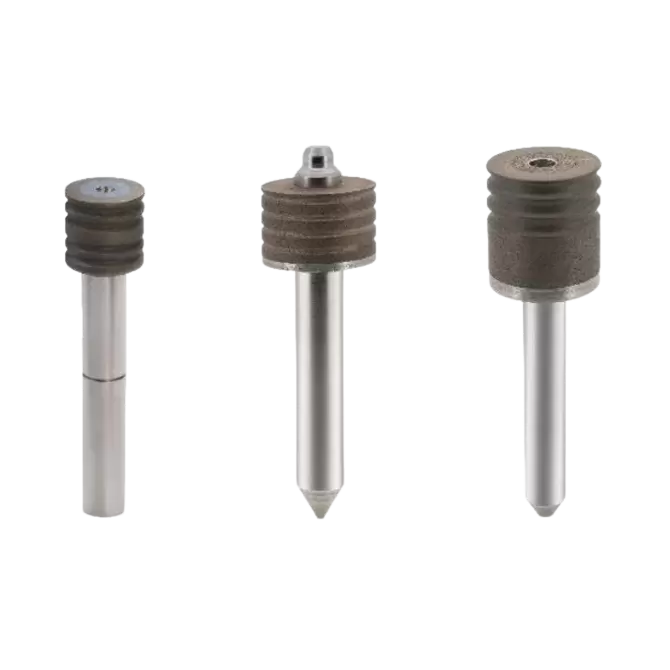
Meijie's grinding wheels for display glass are designed for precision glass processing in the vehicle display industry, including vehicle display cover glass, OGS touch panels, LCD instrument clusters, and industrial control display screens. The application covers corner grinding and terminal edge precision grinding, with support for integrated rough and finish grinding solutions.
The wheel is designed around several requirements discussed throughout this article. Its diamond abrasive formulation provides high cutting sharpness, supporting efficient and smooth edging. The dense and uniform tooth structure promotes heat dissipation and chip discharge, helping maintain a more stable grinding zone during processing. Equipment compatibility is also considered, with the wheel designed for double edging machines from different manufacturers.
The available specifications include wheel diameters of 10–15 mm, shank diameters of 6 mm and 10 mm, and trapezoidal, U-shaped, or grooveless groove configurations. The grit range is 400#–1200#, while the referenced application covers glass thicknesses including 0.5T, 0.7T, and 1.1T.
For processing conditions, the product parameters indicate equipment rotation speeds of 18,000–32,000 r/min, feed rates of 300–1200 mm/min, and grinding depths of 0.1–0.5 mm, divided between rough and finish grinding. These specifications provide a reference for applications requiring controlled edge processing on thin display glass.
The appropriate wheel, however, should always be selected according to the actual glass material, edge geometry, equipment configuration, and required processing result. Product specifications provide the starting point; process validation determines the final operating conditions.
Display glass edge processing requires a higher level of control than basic glass material removal. Sharpness, chipping control, heat dissipation, chip removal, wear resistance, dimensional stability, and machine compatibility all contribute to the quality and consistency of the finished edge.
The requirements also vary according to the processing stage. Corner grinding demands stable profile control, terminal edge grinding requires dimensional consistency and low edge damage, while rough and finish grinding place different priorities on material removal and surface quality.
Processing parameters must be considered together with wheel characteristics. Spindle speed, feed rate, grinding depth, cooling, and equipment configuration can change the interaction between the wheel and the glass. A technically suitable display glass grinding wheel is therefore one that matches the complete processing system rather than one selected from a single specification.
For manufacturers of vehicle displays, OGS touch panels, LCD components, and industrial control displays, evaluating the wheel according to actual workpiece requirements and production conditions provides a more reliable basis for achieving stable edge quality, efficient processing, and consistent dimensional results.